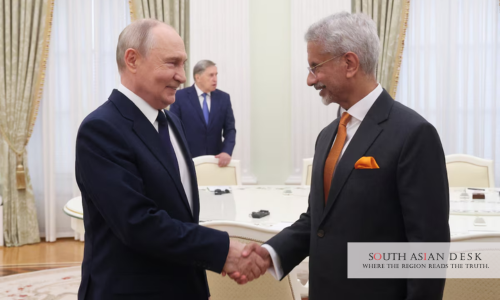
India Russia economic cooperation has expanded considerably in recent years, External Affairs Minister S. Jaishankar told Russian President Vladimir Putin during a meeting at the Kremlin on Monday. Jaishankar’s remarks came on the second day of his official two day visit to Moscow, undertaken at the invitation of Russian First Deputy Prime Minister Denis Manturov, and formed part of a broader review of the strategic relationship between New Delhi and Moscow.
India Russia Economic Cooperation in Focus During Moscow Visit
Speaking to Putin after a morning session of the India Russia Inter-Governmental Commission on Trade, Economic, Scientific, Technological and Cultural Cooperation, Jaishankar said he had a favourable account to share. “I have a very good report that I could share with you regarding our economic cooperation, nuclear energy, fertilizers, and so on,” he said, adding that he would discuss the details further. “Overall, I think our economic cooperation has grown very significantly.”
Jaishankar co-chaired the 27th meeting of the commission, a long standing platform through which the two countries coordinate policy across trade, energy, science, technology and cultural exchange. He opened his remarks to Putin by conveying greetings from Prime Minister Narendra Modi, along with a personal communication for the Russian leader.
Record Bilateral Trade Underpins the Relationship
The minister’s comments follow a period of sustained growth in bilateral trade between the two countries. India’s Commerce and Industry Secretary Amardeep Singh Bhatia said earlier this year that trade between India and Russia reached a record $68.69 billion in the 2025-2026 fiscal year, driven largely by Russian exports of crude oil, fertilisers and coal alongside Indian exports of pharmaceutical and chemical products. Bhatia described the relationship as strong and resilient, noting that the trade figures reflected the complementarity and strategic depth of the economic partnership.
Russian companies have also increased direct investment in India’s energy sector, with firms such as Rosneft committing more than $25 billion toward Indian oil refineries and retail infrastructure. Russian officials have separately projected that bilateral trade could continue growing at a rate of roughly ten percent annually, pointing to expanding Indian exports of machine tools, pharmaceuticals and electronic devices to Russia alongside continued crude oil imports.
Energy, Fertilisers and Nuclear Cooperation on the Agenda
Beyond trade volumes, Jaishankar highlighted energy, fertilisers and nuclear cooperation as specific areas of progress during his meeting with Putin. Russia has remained one of India’s largest suppliers of discounted crude oil since 2022, while cooperation on fertiliser supply has helped support Indian agricultural output. Nuclear energy cooperation between the two countries dates back decades and continues through joint projects, including the Kudankulam nuclear power plant in southern India.
The Russian Ministry of Foreign Affairs said the two countries continue to work together across virtually every area of the relationship, spanning government to government engagement, interparliamentary ties and business community links. Putin, for his part, said he had no doubt that Russian and Indian institutions would continue to cooperate productively, and noted that trade between the countries had grown over the course of the year.
Broader Context of the Intergovernmental Commission
The Intergovernmental Commission meeting that preceded Jaishankar’s talks with Putin is one of the principal mechanisms through which India and Russia manage their economic relationship, bringing together officials from both governments to review progress and set priorities across trade, science, technology and cultural cooperation. Jaishankar’s role as co-chair of the 27th session underscores the continuity of that engagement even as global sanctions pressure on Russia has reshaped trade patterns worldwide.
Russian officials involved in the trade relationship have argued that international sanctions have, if anything, pushed the two countries toward closer cooperation, particularly in financial settlement mechanisms such as rupee-rouble payments, which they say have become more attractive as an alternative to dollar denominated trade.
What This Signals for India-Russia Relations
Jaishankar’s remarks in Moscow reinforce a relationship that both governments have consistently described as a long standing strategic partnership, now increasingly measured in economic as well as diplomatic terms. With bilateral trade at record levels and cooperation continuing across energy, fertilisers and nuclear power, the latest round of talks suggests that India Russia economic cooperation is likely to remain a central pillar of the relationship in the period ahead, even as both countries navigate a shifting global trade and sanctions environment.
Published in SouthAsianDesk, August 25th, 2026
Follow SouthAsianDesk on X, Instagram and Facebook for insights on business and current affairs from across South Asia.