Japan and India have taken a significant step in strengthening their bilateral security arrangement, agreeing to a landmark defence equipment transfer and a new framework for maritime cooperation. The development came just days ahead of the BRICS Summit in India and a day after China voiced strong objections to Japan’s remilitarisation for the first time since the Second World War, underscoring the strategic weight of the announcement.
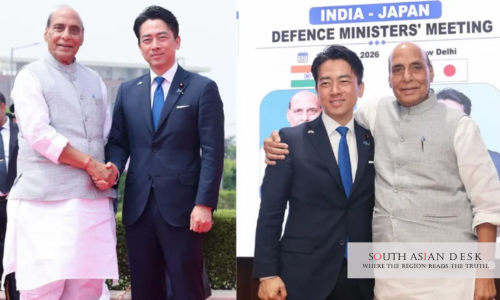
Indian Defence Minister Rajnath Singh and his Japanese counterpart Shinjiro Koizumi held a bilateral meeting in New Delhi on Thursday, where the two sides signalled a deepening of strategic and security ties, particularly in the maritime domain. Although the joint press statement issued by the two ministers did not name China directly, it conveyed a clear intent to expand defence and maritime cooperation between the two countries.
Maritime Security Cooperation Framework Signed
Both ministers expressed firm opposition to unilateral actions that impede freedom and safety of navigation and overflight, as well as to any attempt to alter the status quo through force or coercion. As part of the meeting, Japan and India signed the Memorandum of Arrangement on Maritime Security Cooperation between their respective defence ministries.
According to the joint statement, the memorandum establishes a framework for advancing cooperation in maritime security, including closer coordination between the Japan Maritime Self-Defence Force and the Indian Navy. This encompasses information sharing in the field of Maritime Domain Awareness, along with enhanced cooperation in Search and Rescue operations and Humanitarian Assistance and Disaster Relief efforts.
Koizumi, addressing the meeting, said that Japanese Prime Minister Sanae Takaichi had visited India and agreed with Prime Minister Narendra Modi to strengthen the Japan-India relationship, describing defence cooperation as an indispensable part of that partnership. He noted that Japan-India defence relations had not yet reached the level they should, citing an increasingly complex and uncertain security environment across the Indo-Pacific region, and expressed his intent to work toward elevating the relationship accordingly.
UNICORN Antenna System Marks First Defence Equipment Transfer
A central outcome of the talks was the agreement that India will receive the shipborne UNICORN integrated communications antenna system from Japan, marking the first defence equipment transfer project between the two nations. The move represents a notable evolution in the Japan-India security arrangement, extending cooperation beyond joint exercises and information sharing into tangible hardware transfers.
Affirming their commitment under the Japan-India Special Strategic and Global Partnership, the two ministers welcomed the steady strengthening of defence cooperation between the ministries and armed services of both countries, including the exchange of assessments regarding the regional and international security environment at a time of heightened global tensions.
Deepening Ties Across Multiple Defence Domains
Recognising the protection of Sea Lines of Communication as vital not only to Japan and India but to the wider region and international community, both sides underlined the importance of mutual naval visits, joint exercises, personnel and Subject Matter Expert exchanges, and logistical support, including access to ports and maintenance and repair facilities.
The two countries also agreed to promote exchanges between their respective Special Operations Forces and to pursue cooperation involving India’s integrated theatre commands. Singh welcomed Japan’s recent review of its framework governing the transfer of defence equipment and technology, expressing hope that Japan would continue contributing to peace and stability across the Indo-Pacific region. He further highlighted his expectations for deepening the defence and technology partnership between the two nations.
Both ministers affirmed their commitment to strengthening defence research and development cooperation between India’s Defence Research and Development Organisation and Japan’s Acquisition, Technology and Logistics Agency in the field of advanced defence technologies. They also confirmed their intention to convene a Defence Industry Forum to further this collaboration.
Trilateral Naval Cooperation Also Highlighted
The two ministers welcomed the first trilateral naval PASSEX exercise involving Japan, India, and Indonesia, which was conducted in February this year, reflecting a broader trend toward multilateral maritime engagement among Indo-Pacific partners.
Conclusion
The agreements reached during this meeting mark a substantive advance in the Japan-India security arrangement, moving the relationship from dialogue and joint exercises toward concrete defence equipment transfers and structured maritime cooperation. With regional security dynamics growing more complex, the strengthening of ties between New Delhi and Tokyo, anchored by initiatives such as the UNICORN antenna system and the new maritime security framework, is likely to remain a significant marker of both countries’ strategic alignment in the Indo-Pacific.
Published in SouthAsianDesk, August 22nd, 2026
Follow SouthAsianDesk on X, Instagram and Facebook for insights on business and current affairs from across South Asia.