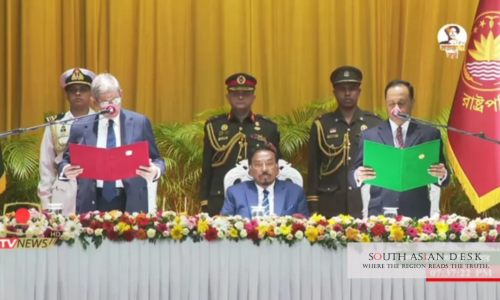
Mirza Fakhrul Islam Alamgir president of Bangladesh became official on Friday evening, as the veteran Bangladesh Nationalist Party leader was sworn in at Bangabhaban following his election earlier in the week. Acting Speaker Barrister Kaiser Kamal administered the oath to the newly elected president at the Darbar Hall at 7:30pm, formally installing him as the country’s head of state.
The ceremony was attended by Prime Minister Tarique Rahman, Acting President Hafiz Uddin Ahmed Bir Bikram, Chief Justice Zubayer Rahman Chowdhury, cabinet members, lawmakers, foreign diplomats, and senior civil and military officials. Special security and traffic arrangements had been put in place in and around Bangabhaban ahead of the event, reflecting the significance attached to the occasion.
Path to the Presidential Election
Alamgir’s rise to the country’s highest constitutional office followed a presidential election held in Parliament on Thursday, in which he secured 255 votes as the candidate of the ruling BNP. His sole rival, Colonel (retd) Oli Ahmed, chairman of the Liberal Democratic Party and the nominee of an eleven party alliance led by Jamaat-e-Islami, received 88 votes. Of the 349 lawmakers registered as voters, 343 cast their ballots, with Chief Election Commissioner AMM Nasir Uddin declaring Alamgir the winner once the count was complete. The Election Commission subsequently issued a gazette notification formally confirming his election.
Notably, this marked the first contested presidential vote in Bangladesh in 35 years, a development that drew close attention both domestically and internationally. The election itself became necessary after Mohammed Shahabuddin, a close aide of former prime minister Sheikh Hasina, resigned from the presidency last month citing health reasons, having not completed his five year term.
Who Is Mirza Fakhrul Islam Alamgir
Born on January 26, 1948, in Thakurgaon, Alamgir comes from a political family. His father, Mirza Ruhul Amin, was a lawyer who was elected to parliament multiple times from the same district, both before and after Bangladesh’s independence. Alamgir completed his higher secondary education at Dhaka College before earning bachelor’s and master’s degrees in economics from the University of Dhaka, where he was also active in student politics during the 1969 uprising against the Ayub Khan administration.
He began his career as a teacher of economics before entering government service, and later served as private secretary to a deputy prime minister during the administration of President Ziaur Rahman. Alamgir joined the BNP in the early 1990s during the anti-Ershad movement and steadily rose through its ranks, eventually being appointed senior joint secretary general in 2009. He became acting secretary general of the party in 2011 and was confirmed in the position in 2016, holding the post until his resignation last month to contest the presidency.
Over more than two decades as one of the BNP’s most prominent leaders, Alamgir served as a member of parliament for the Thakurgaon-1 constituency and held state minister portfolios for agriculture and later civil aviation and tourism between 2001 and 2006. Following the BNP’s victory in the 13th National Parliamentary Election, he was elected again from Thakurgaon-1 and took the oath as Minister of Local Government, Rural Development and Cooperatives on February 17, a post he held until his party nominated him for the presidency.
Significance for Bangladesh
The election of Mirza Fakhrul Islam Alamgir president of Bangladesh comes at a pivotal juncture for the country, following a period of political transition after Sheikh Hasina’s departure from power and the tenure of an interim government. As the 23rd president of Bangladesh, Alamgir now assumes a largely ceremonial but constitutionally significant role, one that carries symbolic weight given the BNP’s return to prominence in national politics.
With his oath taking now complete, attention will turn to how the presidency under Alamgir shapes the country’s institutional relationships in the months ahead, particularly given the contested nature of the vote and the continuing political realignments that have followed Bangladesh’s recent period of upheaval.
Published in SouthAsianDesk, August 24th, 2026
Follow SouthAsianDesk on X, Instagram and Facebook for insights on business and current affairs from across South Asia.