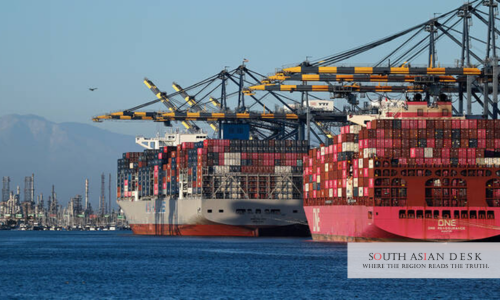
Pakistan orders container ships for its state-run shipping carrier as the country works to shore up trade links with Gulf markets amid prolonged maritime disruption caused by the Iran war. A spokesperson for the national carrier confirmed that the acquisition plan is aimed at strengthening regional shipping capacity at a time when conflict in the region continues to strain commercial vessel traffic and drive up freight costs for exporters who depend on Gulf markets.
Why Pakistan Is Strengthening Its Fleet Amid Gulf Trade Disruption
The Iran war, which began in late February, has severely disrupted shipping through the Strait of Hormuz, a waterway that once carried about a fifth of global oil and liquefied natural gas flows. The prolonged instability has pushed up freight costs and complicated logistics for Pakistani exporters, even as overall trade with Gulf Cooperation Council countries has shown periods of recovery in recent months.
Ayesha Leena, spokesperson for the Pakistan National Shipping Corporation, said the carrier is considering the acquisition and chartering of three to five feeder vessels to expand its regional service capacity in line with its fleet development strategy. Each vessel under consideration would have a container capacity ranging from 1,100 to 2,000 twenty-foot equivalent units, the standard measure used across the shipping industry. Leena added that the corporation expects to announce its expanded regional feeder services in the near future, though no exact timeline has been confirmed.
The Pakistan National Shipping Corporation currently operates five bulk carriers and eight tankers across three regional routes, namely the Pakistan Gulf Service, the Pakistan Red Sea Service and the Pakistan South Asia Service, which links Karachi with Colombo and Chittagong. The corporation has also expanded regional connectivity this year through a dedicated Gulf feeder link between Karachi and Fujairah.
Strait of Hormuz Shipping Disruption and Its Impact on Exports
Data from the Federation of Pakistan Chambers of Commerce and Industry shows a volatile pattern in exports to the six Gulf Cooperation Council countries since the conflict began. Exports rose 25.2 percent year on year in February before contracting through the following months, falling 2.9 percent in March, 10.6 percent in April and 16.7 percent in May. The figures rebounded by 13.9 percent in June and grew a further 4.7 percent year on year in July, according to Mian Zahid Hussain, chairman of the Policy Advisory Board at the federation.
Between January and July 2026, Pakistan exported goods worth 1.944 billion dollars to Gulf Cooperation Council countries, a rise of 2.1 percent compared with the same period the previous year. The United Arab Emirates accounted for nearly two-thirds of that total, prompting the federation to describe the overall trade performance as resilient but concentrated.
The monthly fluctuations closely tracked developments in the regional conflict. The Iran war began on February 28, followed by a temporary ceasefire in April and several months of negotiation. An interim agreement reached in June began to unravel in July amid renewed disputes over the Strait of Hormuz, and the waterway remains severely disrupted following the collapse of that agreement.
A Commerce Ministry official, speaking on condition of anonymity, said the uncertainty had affected buying decisions across Middle Eastern markets. According to the official, businesses tend to hold back orders during unstable conditions since demand does not move uniformly across sectors, with imports and exports of essential goods such as food and medicine continuing even as purchases of clothing and other non-essential items are often deferred.
Rising Freight Costs Hit Pakistani Exporters
The official noted that elevated ocean freight rates had left exporters with few viable alternatives, pointing out that air freight now averages between 2.00 and 2.50 dollars per kilogram, compared with 1,800 to 2,000 dollars for a standard sea container carrying around ten metric tons.
Exporters of perishable goods have been among the hardest hit by the shipping disruption. Waheed Ahmed, patron in chief of the All Pakistan Fruit and Vegetable Exporters, Importers and Merchants Association, said the cost of shipping a 40-foot refrigerated container of mangoes to Gulf markets had surged to between 8,000 and 8,500 dollars this year, up sharply from 1,000 to 1,400 dollars last year. Ahmed estimated that Pakistan’s mango export volumes to Gulf countries had fallen by 50 percent compared with the previous year, while overall fruit exports to the region were down between 30 and 40 percent.
The sharp decline in fruit shipments, despite an overall increase in exports to Gulf Cooperation Council countries, illustrates the uneven impact of the maritime disruption, with certain sectors and export markets absorbing higher freight costs more easily than others.
Outlook for Pakistan’s Shipping Capacity
Industry observers say that strengthening the national carrier’s fleet could reduce Pakistan’s dependence on foreign shipping lines and provide more reliable connections to Gulf markets over the long term. The federation noted that the government had already been pursuing a broader expansion of the carrier’s fleet before the latest wave of regional disruptions, suggesting that the current directive builds on an existing strategy rather than representing an entirely new response to the crisis.
The push for additional container capacity comes as renewed hostilities continue to weigh on commercial shipping across the region. Iran has said the Strait of Hormuz will remain closed until Washington fulfils the conditions set out in the June interim agreement, and diplomatic efforts to revive that deal have so far stalled, leaving the outlook for regional maritime trade uncertain in the near term.
Published in SouthAsianDesk, August 24th, 2026
Follow SouthAsianDesk on X, Instagram and Facebook for insights on business and current affairs from across South Asia.