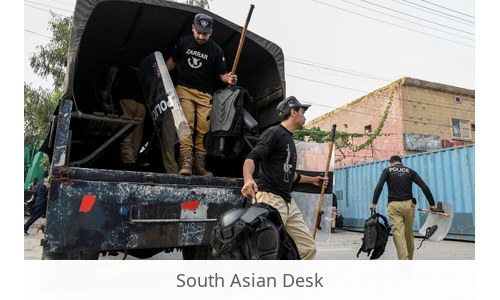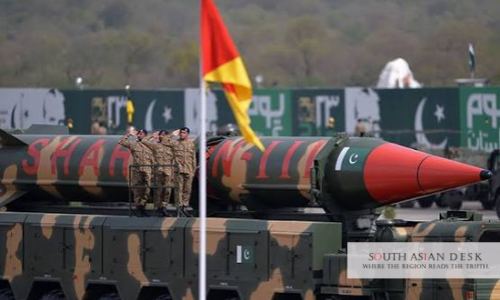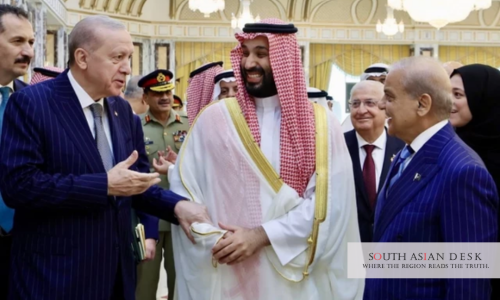
The Pakistan-Saudi-Turkiye defence pact has drawn fresh attention to the long history of military alliances built on the principle of collective defence. A week after Saudi Arabia, Pakistan and Turkiye signed their joint defence agreement, Turkiye’s defence ministry disclosed further details of the arrangement, including plans for joint military exercises and closer cooperation between the three countries’ defence industries.
The agreement between three of the largest economies among Muslim-majority nations arrives at a time of heightened military tension across the Middle East, including the continuing US-Israeli war on Iran, during which Saudi Arabia has repeatedly come under Iranian fire targeting American military assets in the Gulf.
What the Pakistan-Saudi-Turkiye Defence Pact Involves
According to Pakistan’s foreign ministry, the pact states that an armed attack on any one of the three countries will be regarded as an attack on all of them, a clause that closely mirrors NATO’s Article 5 collective defence provision. Turkiye’s defence ministry, briefing reporters in Ankara, said the pact’s core aim was to place defence and military cooperation between the three countries on a more institutional and lasting footing, with strategic mechanisms to be established involving defence ministers, foreign ministers and military chiefs.
The pact follows a visit by Pakistan’s Prime Minister, Shehbaz Sharif, and army chief Asim Munir to Saudi Arabia to perform the Umrah pilgrimage, after which Turkish President Recep Tayyip Erdogan travelled to Mecca to meet Saudi Crown Prince Mohammed bin Salman. Turkiye, which fields NATO’s second-largest army, has indicated the agreement with nuclear-armed Pakistan and major oil exporter Saudi Arabia remains open to expansion, with Egypt named as a possible future member. Officials from all three countries have stressed that the pact is not intended to replace existing alliances.
Why the Pakistan-Saudi-Turkiye Defence Pact Follows a Familiar Pattern
Mutual defence agreements of this kind are not new, and history offers several precedents with mixed records of success. Analysts note that such pacts can deter large-scale interstate war between their members, but their usefulness tends to fall away once conflict shifts into a grey zone that includes occupation, internal repression or proxy violence. In many cases, experts argue, these arrangements function more as a signal of political alignment than as a genuine collective defence mechanism.
NATO and the Origins of Article 5
The best-known example of a mutual defence agreement is the North Atlantic Treaty Organisation, formed in 1949 largely in response to fears of Soviet expansion during the Cold War. The founding members, including the United States, Canada, the United Kingdom and several Western European states, signed the original treaty in April 1949. NATO has since grown into a 32-member alliance, with Sweden the most recent country to join.
Under NATO Article 5, an attack on one member state in Europe or North America is treated as an attack on all, effectively placing Western Europe under the American nuclear umbrella. NATO has invoked Article 5 only once, following the September 11, 2001 attacks on the United States. Many historians credit the treaty with discouraging direct confrontation between NATO members and the Soviet-led Warsaw Pact throughout the Cold War.
Regional and Bilateral Mutual Defence Agreements
Several other collective defence pact arrangements have shaped regional security over the past eight decades. The Arab League’s Joint Defence and Economic Cooperation Treaty, signed in 1950, declared that an attack on one Arab state would be treated as an attack on all, though its practical application has been limited.
In the Americas, the Inter-American Treaty of Reciprocal Assistance, also known as the Rio Treaty, was signed in 1947 and invoked during both the 1962 Cuban missile crisis and the September 11 attacks. The ANZUS Treaty, signed by the United States, Australia and New Zealand in 1951, was invoked for the first time after September 11, although Washington suspended its security obligations to New Zealand in 1986 over the country’s anti-nuclear stance.
Bilateral mutual defence agreements have also endured in Asia. The US-Japan Security Treaty, signed in San Francisco in 1951, has never been formally invoked but underpins the presence of roughly 50,000 American troops in Japan. Similarly, the US-South Korea Mutual Defence Treaty, which took effect in 1954 after the Korean War, has never been invoked yet provides the legal basis for about 28,500 US troops stationed in South Korea.
Gulf and European Frameworks
Closer to the Pakistan-Saudi-Turkiye defence pact geographically, the Gulf Cooperation Council established the Peninsula Shield Force in 1984 to defend its six member states during the Iran-Iraq War. The force, made up of roughly 40,000 personnel drawn from Bahrain, Kuwait, Oman, Qatar, Saudi Arabia and the United Arab Emirates, was followed by a 2000 joint defence agreement aimed at developing a shared arms manufacturing industry. The GCC pledged to activate its joint defence mechanism after Israel struck Hamas leaders in Qatar in September 2025.
In Europe, the Treaty on European Union, agreed in 2009, created a mutual defence obligation under Article 42(7), requiring member states to assist a fellow member facing armed aggression. France invoked this clause only once, after the 2015 Paris attacks, prompting other EU states to provide bilateral military support so French forces could be redeployed at home.
A separate example is the Collective Security Treaty Organisation, a Russia-led alliance established in 2002 comprising Russia, Armenia, Kazakhstan, Kyrgyzstan, Tajikistan and Belarus. Its Article 4 states that aggression against one member is aggression against all. The CSTO has deployed troops under this clause only once, in 2022, when Kazakhstan requested assistance to manage unrest triggered by rising fuel prices.
What the Pakistan-Saudi-Turkiye Defence Pact Signals
Taken together, these precedents suggest that mutual defence agreements rarely function exactly as written. Their deterrent value against conventional war between member states is well documented, but their record in addressing grey-zone conflict, internal unrest or proxy warfare is far less consistent. Whether the Pakistan-Saudi-Turkiye defence pact will follow the pattern of NATO’s durable Article 5 or the more symbolic record of agreements such as the Arab League treaty will depend on how the three countries choose to institutionalise it in the years ahead.
Published in SouthAsianDesk, August 15th, 2026
Follow SouthAsianDesk on X, Instagram and Facebook for insights on business and current affairs from across South Asia.