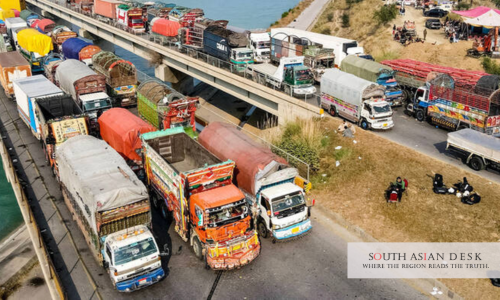
The Pakistan transporters strike entered its ninth day on Sunday as goods carriers met a senior government delegation in Karachi, seeking a resolution to a dispute that has disrupted the movement of imports, exports and essential supplies across the country. Representatives of the All-Pakistan Goods Transport Owners Association held talks with officials at the Sindh Governor House in an effort to end a shutdown that has left cargo stranded at ports and choked freight corridors nationwide.
Pakistani goods transporters launched the strike a week earlier in protest against the government’s practice of revising diesel rates on a daily basis. They have also demanded changes to toll taxes and called on authorities to strictly enforce existing axle-load regulations, which govern how much weight a truck is permitted to carry on national highways and motorways.
Pakistan Transporters Strike – Government Delegation Meets Transport Association Over Diesel Price Revisions
Federal Communications Minister Abdul Aleem Khan led the government’s delegation, joined by the transport ministers of Sindh and Punjab, in Sunday’s meeting with association representatives. The talks were intended to address grievances that transporters say have made it increasingly difficult to manage freight costs, chief among them the near-daily adjustment of diesel prices.
“We firmly believe that our strike will continue until our demands are accepted and a formal notification is issued,” said Mohammad Owais Chaudhry, the association’s president. He said transporters were pressing for the fuel pricing mechanism to shift from a daily system to a monthly or fortnightly one, arguing that frequent revisions leave operators unable to plan freight rates with any certainty.
Chaudhry added that transporters were also seeking a workable and consistently enforced system for axle-load regulations, alongside a reduction in toll charges levied on goods vehicles. He said around 400 vehicles were currently participating in the strike and that port operations had been severely affected as a result.
Impact on Karachi’s Ports and Supply Chains
The standoff carries particular weight for Karachi, Pakistan’s principal commercial hub, where extended disruptions to cargo movement have left import and export consignments stranded and exposed to mounting demurrage and detention charges. With approximately 400 vehicles off the road, transport industry figures say the backlog at the city’s ports has grown steadily since the strike began, adding pressure on businesses reliant on the timely clearance of goods.
Chaudhry said transporters had received verbal assurances from government officials over the preceding four to five days but remained unwilling to call off the strike without a written and legally binding executive order. Khan did not respond to a request for comment on the transporters’ position.
Earlier Attempts to Resolve the Dispute
This is not the first round of negotiations between the two sides since the strike began. Talks were also held earlier in the week, and on Tuesday the government agreed to set up a Joint Monitoring Committee comprising Customs authorities and transporter representatives to work through the sector’s concerns. Khan has additionally called for the installation of modern weigh stations, with minimal human intervention, at points along the country’s motorways to make enforcement of axle-load regulations more consistent and less dependent on manual checks.
Despite these steps, transporters have maintained that only a formal, written commitment from the government will be sufficient to end the strike. With the dispute now well into its second week, the outcome of Sunday’s talks in Karachi is likely to determine whether cargo movement across Pakistan’s ports and highways can resume in the days ahead, or whether the standoff over diesel price revisions, toll taxes and axle-load enforcement will continue to weigh on the country’s supply chains.
Published in SouthAsianDesk, August 17th, 2026
Follow SouthAsianDesk on X, Instagram and Facebook for insights on business and current affairs from across South Asia.