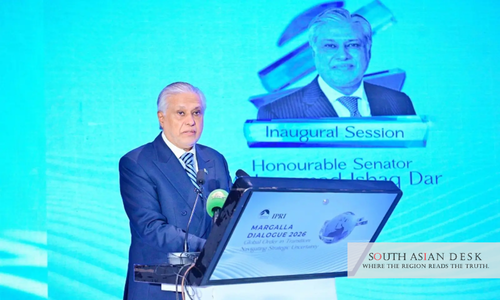
Pakistan’s diplomatic strategy is increasingly centred on maintaining constructive relations with competing global powers while navigating an international environment shaped by geopolitical rivalries, regional conflicts and shifting security alliances. Deputy Prime Minister and Foreign Minister Ishaq Dar reiterated this approach on November 10, 2026, while addressing the inaugural session of the Margalla Dialogue 2026 in Islamabad, calling for stronger international cooperation, effective diplomacy and a renewed commitment to peaceful conflict resolution.
Organised by the Islamabad Policy Research Institute (IPRI), the two-day conference brought together Pakistani policymakers, international academics, diplomats and security experts to discuss the changing global order. This year’s theme, ‘Global Order in Transition: Navigating Strategic Uncertainty’, reflected growing concerns about the future of international relations and the implications of intensifying competition among major powers.
Dar argued that Pakistan’s ability to navigate the emerging international environment would depend on two interconnected priorities: strengthening its domestic foundations and pursuing effective diplomacy abroad. He maintained that the country would continue advocating regional peace while firmly protecting its sovereignty and national interests.
Pakistan’s Diplomatic Strategy in an Emerging Multipolar World
A central theme of Dar’s address was the uncertainty surrounding the international political system. Intensifying competition between major powers, prolonged armed conflicts and the weakening of existing arms control arrangements have placed increasing pressure on the international security architecture.
The foreign minister warned that the decisions made by countries during this period of transition would determine whether the emerging global order produced greater cooperation or deeper confrontation.
The discussions at Margalla Dialogue 2026 also examined the transition from a predominantly unipolar international system towards a multipolar arrangement involving several influential powers. American political scientist Professor John J. Mearsheimer of the University of Chicago argued that the United States, China and Russia had emerged as the principal great powers shaping international politics.
For Pakistan, this transition presents both opportunities and challenges. Mearsheimer argued that Islamabad was in a strategically advantageous position because it maintained cordial relations with both Washington and Beijing. He suggested that Pakistan should capitalise on these relationships rather than allow international competition to force it into choosing between the two.
He also emphasised the importance of economic development, arguing that Pakistan would need to strengthen its wealth-creation capacity if it aspired to become a more influential middle power.
Pakistan’s Relations With China, the United States and Regional Powers
Pakistan’s foreign policy has traditionally relied on maintaining relationships with multiple international partners, and Dar reiterated the importance of this approach during his address.
He described the relationship with China as a cornerstone of Pakistan’s foreign policy while highlighting the importance of constructive engagement with the United States. He also referred to expanding cooperation with Saudi Arabia, Turkiye, Iran, Gulf countries, Europe and Central Asia.
Maintaining relationships with Washington and Beijing simultaneously is particularly significant given the strategic competition between the two countries. While China’s economic and strategic partnership with Pakistan remains important, engagement with the United States continues to carry considerable diplomatic and economic significance.
The challenge for Islamabad is to preserve these relationships without becoming directly entangled in the geopolitical rivalries between major powers.
The discussions at the Margalla Dialogue also highlighted the importance of Pakistan’s geographical position. Situated at the intersection of South Asia, Central Asia and the Middle East, Pakistan has significant opportunities to strengthen regional connectivity, trade and economic cooperation.
However, realising this potential will require domestic economic stability, consistent foreign policy priorities and sustained diplomatic engagement.
Makkah Joint Defence Agreement and Regional Security
Dar also addressed Pakistan’s evolving security partnerships, particularly the Makkah Joint Defence Agreement involving Saudi Arabia and Turkiye.
He described the arrangement as defensive in nature, intended to strengthen collective security and credible deterrence rather than target any particular country.
The agreement reflects the growing importance of regional security cooperation at a time when conflicts and strategic rivalries are affecting several parts of the Middle East and South Asia.
For Pakistan, closer defence cooperation with regional partners also carries economic and diplomatic significance. Its longstanding relationship with Saudi Arabia, combined with expanding engagement with Turkiye and other Gulf countries, provides opportunities for cooperation across multiple sectors.
Nevertheless, the effectiveness of such partnerships will depend on their ability to promote stability without contributing to further regional polarisation.
Pakistan Calls for Peaceful Resolution of Regional Disputes
Addressing regional conflicts, Dar reiterated Pakistan’s position that lasting peace in South Asia requires a just settlement of the Jammu and Kashmir dispute in accordance with United Nations Security Council resolutions.
He also warned against what he described as India’s attempts to weaponise water, maintaining that Pakistan would protect its rights under the Indus Waters Treaty.
Relations between Pakistan and India remain a significant challenge for regional stability, particularly given the longstanding disputes between the two nuclear-armed neighbours. The diplomatic position outlined by Dar suggests that Islamabad intends to continue advocating peaceful resolution while maintaining its position on issues it considers central to national security.
Afghanistan also featured prominently in the foreign minister’s address. Dar described terrorism originating from Afghan territory as a serious security challenge and emphasised Pakistan’s responsibility to protect its citizens.
At the same time, he reiterated support for a peaceful, stable and economically integrated Afghanistan. This reflects the importance Islamabad attaches to regional connectivity and stability, particularly given Afghanistan’s geographical position between Pakistan and Central Asia.
Pakistan’s Role in US-Iran Diplomacy
The Middle East was another major focus of the discussions, particularly the ongoing tensions involving Iran, Israel and the United States.
Dar referred to Pakistan’s facilitation of the Islamabad talks between Washington and Tehran in April 2026 as an example of its commitment to resolving international disputes through dialogue.
Pakistan’s diplomatic engagement with both Iran and the United States places it in a potentially important position when efforts are made to reduce tensions between the two countries. However, sustaining this role requires careful diplomatic balancing, particularly when regional conflicts threaten to affect the interests of multiple international partners.
During the conference, Professor Mearsheimer offered a sharply critical assessment of American involvement in the war against Iran, arguing that Washington had underestimated the challenges associated with military confrontation.
He also criticised the Trump administration’s decision-making and described American involvement in the conflict as strategically misguided.
Middle East scholar Dr Vali Nasr similarly discussed Iran’s resilience and the wider consequences of the conflict for regional security. He argued that developments involving Iran and Israel could have implications extending beyond the Middle East, including potential security concerns for Pakistan.
Former American diplomat Robin Raphel also warned about the wider implications of international tensions, particularly in relation to the global nuclear non-proliferation framework. She noted that an Iranian withdrawal from the Nuclear Non-Proliferation Treaty could encourage other countries to reconsider their own commitments.
Margalla Dialogue 2026 Highlights Pakistan’s Changing Diplomatic Priorities
The discussions at Margalla Dialogue 2026 highlighted the increasingly complex environment in which Pakistan must formulate its foreign policy.
The transition towards a multipolar world offers Islamabad opportunities to strengthen its international partnerships, but it also increases the importance of maintaining diplomatic flexibility. Relations with China, the United States, Saudi Arabia, Turkiye and Iran will require careful management as international rivalries continue to evolve.
Dar’s emphasis on domestic strength also points to an important limitation of Pakistan’s international ambitions. Diplomatic influence cannot be sustained through international engagement alone. Economic stability, institutional capacity and national development remain essential foundations of an effective foreign policy.
Ultimately, Pakistan’s diplomatic strategy will be tested by its ability to translate international relationships into tangible economic and security benefits while avoiding unnecessary involvement in external conflicts. The Margalla Dialogue provided an important platform for examining these challenges and considering Pakistan’s position in an increasingly uncertain global order.
As geopolitical competition intensifies, Islamabad’s ability to maintain constructive relations across competing power centres could become one of its most significant diplomatic assets.
Follow SouthAsianDesk on X, Instagram and Facebook for insights on business and current affairs from across South Asia.