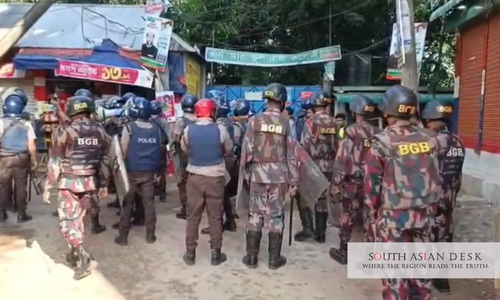
Savar Ashulia worker-police clashes continued on Wednesday, 11 November 2026, as garment workers staged fresh demonstrations demanding higher wages, disrupting operations at several factories across the industrial belt. Police used tear gas and sound grenades to disperse protesters after some workers attempted to block roads, leading to repeated confrontations and chases in different parts of the area.
The unrest unfolded in the Jamgora area of Ashulia and Hemayetpur in Savar, where workers at several garment factories stopped working to press their demands. Although many employees initially arrived at their workplaces and began their shifts as usual, work stoppages and demonstrations subsequently spread to a number of factories.
According to reports, factory authorities in parts of Jamgora announced holidays at around 9:30am after workers halted production. As employees left the premises and attempted to block nearby roads, police intervened to disperse the crowds. Officers fired tear gas and sound grenades, triggering several rounds of clashes between workers and law enforcement personnel.
A similar situation developed in Hemayetpur shortly after 10am. Workers from several factories gathered on the streets and attempted to obstruct traffic. Police again used tear gas to disperse the demonstrators, as tensions spread across the industrial belt.
No casualties had been reported in Wednesday’s incidents at the time Dhaka Tribune published its report. However, the confrontations added to several days of labour unrest in the country’s important garment manufacturing areas.
Savar Ashulia Worker-Police Clashes Reflect Continuing Wage Dispute
The demonstrations form part of a wider movement by Bangladesh’s garment workers seeking an increase in the minimum monthly wage. Workers have been demanding a minimum salary of Tk 30,000, arguing that existing wages have become increasingly inadequate amid rising living costs.
The dispute has continued despite steps taken by the government to address wage concerns through a wage board. On 4 November, Reuters reported that the newly formed six-member wage board had agreed to introduce a revised pay structure from December. Workers are expected to receive their first salaries under the new scale in January. However, the board had not yet determined the amount of the increase, leaving a central issue unresolved.
Workers have maintained that a substantial adjustment is necessary to meet the cost of essential expenses, including food, housing and transport. The demand for Tk 30,000 represents a significant increase from the existing minimum monthly wage of Tk 12,500.
The continuing uncertainty over the revised wage structure has contributed to frustration among workers, particularly as demonstrations have persisted across several manufacturing centres. The latest confrontations in Savar and Ashulia indicate that the government’s wage-setting process has not yet brought the industrial dispute to an end.
Factory Closures and Disruptions Across the Ashulia Industrial Area
The renewed protests have also affected factory operations. On Wednesday, an Industrial Police source told Dhaka Tribune that production remained normal at most garment factories across the industrial belt despite work stoppages and unrest at several facilities.
However, authorities at a number of factories in Jamgora announced holidays after workers stopped working. The precise number of factories affected on Wednesday could not immediately be established. Dhaka Tribune reported that attempts to contact Industrial Police-1 Superintendent of Police Mohammad Mominul Islam Bhuiyan for further details were unsuccessful.
The latest closures follow disruptions reported a day earlier. On 10 November, at least two garment workers were injured during confrontations with police in the Jamgora area. Authorities also announced holidays at around 20 factories following the unrest, according to a separate Dhaka Tribune report.
The circumstances surrounding the injuries were disputed. Hospital officials said the workers had injuries suspected to have been caused by rubber bullets, while the Ashulia Industrial Police superintendent denied that officers had fired rubber bullets. He maintained that police had used tear gas and sound grenades after attempts to persuade workers to end a road blockade failed.
Other media reports gave higher estimates of factory closures and injuries during Tuesday’s unrest. These differing accounts underline the difficulty of establishing a single confirmed figure for the full scale of the disruption.
Bangladesh Garment Industry Faces Continued Labour Unrest
The protests in Savar and Ashulia are significant because the areas form part of Bangladesh’s major ready-made garment manufacturing network. The garment industry is central to the country’s export economy and provides employment to millions of people. Prolonged disruptions can therefore affect not only workers and factory owners but also production schedules and the fulfilment of international orders.
Reuters has reported that the continuing demonstrations have raised concerns about factory operations and export deliveries. International buyers depend on reliable production and shipment schedules, particularly when orders are tied to specific seasonal deadlines. Extended closures and repeated interruptions could place additional pressure on manufacturers already dealing with rising costs and competition in international markets.
At the same time, the wage dispute highlights the economic pressures facing garment workers. Factory operations depend on a large workforce, while workers argue that their earnings have not kept pace with the cost of living. A resolution will require an approach that addresses workers’ concerns while providing manufacturers with a clear and workable framework for implementing revised wages.
The immediate situation remains uncertain. Although Industrial Police sources indicated that production continued normally at most factories on Wednesday, fresh demonstrations and confrontations showed that tensions had not subsided. The number of factories affected may also change as individual managements respond to developments on the ground.
The wage board’s pending decision on the size of the increase is likely to remain central to the dispute. Until workers receive clarity on the proposed pay structure and their other concerns are addressed, the possibility of further demonstrations cannot be ruled out.
For Bangladesh’s garment sector, restoring stability will depend not only on maintaining security around factories but also on finding a credible resolution to the underlying labour dispute. The latest Savar Ashulia worker-police clashes demonstrate that factory closures and police intervention have not, by themselves, brought the wage protests to an end.
Follow SouthAsianDesk on X, Instagram and Facebook for insights on business and current affairs from across South Asia.