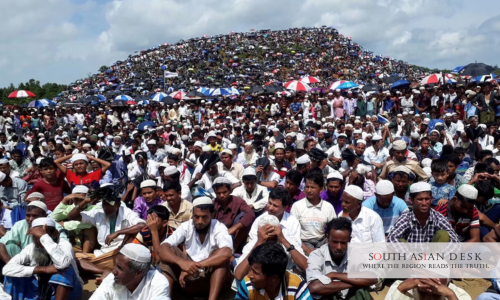
Rohingya repatriation from Myanmar to Bangladesh remains stalled even after the country’s military backed government confirmed that nearly 309,000 displaced people currently living in camps in Bangladesh are former residents of Rakhine State. In a statement issued over the weekend, Myanmar’s foreign ministry said the return process would only move forward once security conditions in Rakhine improve.
Rohingya Repatriation From Myanmar: Verification Numbers and Outstanding Cases
According to the foreign ministry, Myanmar has verified 308,797 displaced people in Bangladesh as former residents of Rakhine State out of 828,824 names submitted as of July 31, 2026. The figures leave a substantial gap between the total number of names submitted for consideration and those the government has formally confirmed as eligible former residents.
Myanmar’s government also said it had identified 4,241 individuals on Bangladesh’s repatriation list who it alleges were involved in terrorist activity, a designation that would exclude them from the verified group. A further 113,507 names could not be verified at all, according to the statement, leaving their status unresolved for now.
Scale of the Displacement
The Rohingya, a predominantly Muslim minority, have faced decades of statelessness and discrimination in Myanmar, where they have historically been denied citizenship. According to United Nations figures, more than 700,000 Rohingya fled to neighbouring Bangladesh in 2017 following a crackdown by Myanmar’s security forces, joining earlier waves of refugees who had crossed the border in previous years. Many people continue to leave Myanmar through uncertain and often dangerous sea and land journeys, even as the repatriation question remains unresolved for those already sheltering in Bangladesh’s crowded camps.
Security Situation in Rakhine State
Central to the delay is the ongoing conflict in Rakhine State, where Myanmar’s military continues to fight the Arakan Army, an ethnic armed group that has been seeking greater autonomy for the region. The fighting has left large parts of Rakhine unstable, complicating any effort to resettle returning Rohingya safely and raising doubts about whether conditions on the ground could support a large scale repatriation in the near term.
Myanmar’s government has consistently linked the pace of repatriation to improvements in this security situation, a position reiterated in the latest statement. Rights groups and refugee advocates have long questioned whether conditions in Rakhine are genuinely suitable for return, given the continued unrest and the broader history of displacement and violence in the region.
Wider Regional Developments
The repatriation issue extends beyond Bangladesh as well. Myanmar has separately agreed to take back 5,000 Rohingya asylum seekers currently in Malaysia, though Malaysian authorities have said that any such repatriation would not proceed if it placed those individuals’ lives at risk. The stance reflects broader regional caution around returning Rohingya refugees to Myanmar while the security and citizenship questions underlying their original displacement remain unresolved.
With verification numbers now confirmed for hundreds of thousands of displaced people, attention is likely to shift toward what concrete steps, if any, Myanmar’s government takes to stabilise Rakhine State and set a credible timeline for repatriation, a process that has repeatedly stalled since the crisis began nearly a decade ago.
Published in SouthAsianDesk, August 18th, 2026
Follow SouthAsianDesk on X, Instagram and Facebook for insights on business and current affairs from across South Asia.