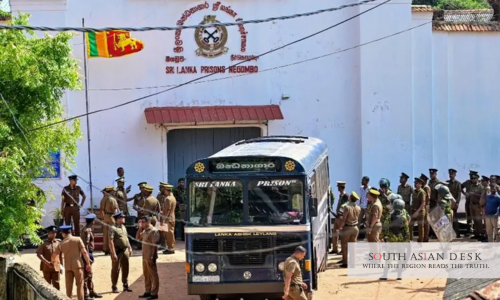
Sri Lanka prison overcrowding has come under renewed scrutiny after a deadly riot at Negombo Prison killed 28 people, forcing the government to announce emergency measures to ease pressure on a detention system operating far beyond capacity.
The riot, one of the country’s deadliest prison incidents in years, left 20 inmates and eight prison officials dead after two days of violence inside the facility, located north of Colombo. Authorities say the unrest erupted between rival groups of inmates and was linked to drug smuggling inside the prison.
The violence has exposed a crisis that rights groups, prison officials and legal experts have warned about for years. Sri Lanka’s prisons are severely overcrowded, understaffed and increasingly filled with people detained over drug-related offences. The government is now moving to expand prison space, review laws on house arrest and examine alternatives for low-risk detainees.
Sri Lanka prison overcrowding reaches crisis point
Sri Lanka prison overcrowding is not a new problem, but the Negombo riot has pushed it to the centre of national debate.
Negombo Prison was built to hold about 650 inmates but was housing around 2,400 at the time of the violence. That level of congestion made the facility difficult to manage and left both inmates and prison officers exposed to serious security risks.
The national picture is even more alarming. Sri Lanka’s 22 prisons hold about 41,000 inmates, nearly four times their intended capacity. The justice system has struggled to keep pace with rising arrests, slow trials and growing detention linked to narcotics cases.
Officials say drug-related prisoners now account for 65.5 percent of Sri Lanka’s inmate population. That figure is central to the current crisis. It suggests that prison overcrowding is being driven not only by a shortage of cells, but also by criminal justice policies that send large numbers of drug users, couriers and low-level offenders into already strained facilities.
The Negombo riot has therefore become more than a security incident. It has become a warning about the limits of a prison system that can no longer safely absorb the number of people being sent into custody.
Negombo prison riot linked to drug smuggling dispute
The immediate trigger for the Negombo prison riot was reportedly a dispute linked to drug smuggling inside the facility. Justice Minister Harshana Nanayakkara said earlier that the clash began after some prisoners allegedly provided information to officials about attempts to smuggle drugs into the prison.
According to the government’s account, another group of inmates connected to the smuggling operation reacted violently. The situation escalated when prison officers intervened, and the fighting spread over two days.
Authorities said inmates attacked prison officials with bricks and clubs. Some prisoners also attempted to escape during the violence. Prison guards later opened fire, saying they acted in self-defence and to restore control.
The riot exposed the dangerous combination of overcrowding, contraband networks and limited staff capacity. In such conditions, prison authorities may struggle to separate rival groups, protect informants, prevent smuggling or respond quickly when violence breaks out.
The attack also showed how prisons can become centres of organised criminal activity when enforcement inside facilities is weak. If drug networks operate from within prisons, overcrowding can strengthen their influence by giving them more recruits, more hiding places and greater ability to intimidate other inmates.
Government announces emergency capacity measures
In response to the crisis, Sri Lanka has announced several steps to expand prison capacity.
The government plans to reopen a colonial-era prison that had previously been earmarked for conversion into a hotel. Authorities are also moving to convert part of a closed hospital into a detention facility, while a new prison is being planned at a navy camp.
One of the proposed sites is the disused Mahamodara hospital building in Galle District. Officials have been instructed to prepare the site with security arrangements and essential prison infrastructure before inmates can be transferred there.
These steps may provide short-term relief, but they also raise practical questions. A hospital or colonial-era building cannot function as a secure prison without major upgrades. Authorities will need to install secure accommodation areas, surveillance systems, controlled entry points, medical arrangements, segregation units, kitchens, sanitation facilities and staffing structures.
Expanding capacity may reduce immediate congestion, but it will not resolve the underlying cause of Sri Lanka prison overcrowding if the number of detainees continues to rise. Without reforms in arrest, bail, trial and sentencing policy, new facilities may quickly become overcrowded as well.
House arrest law under review
The government is also reviewing laws that could allow house arrest for low-risk detainees. This proposal is significant because it recognises that prison overcrowding cannot be solved only by building more prisons.
House arrest could allow some people to remain under legal supervision outside prison, particularly where detention is not necessary for public safety. If carefully designed, such a system could reduce pressure on prisons while allowing authorities to monitor offenders through reporting requirements, electronic surveillance or other legal conditions.
However, the success of a house arrest system would depend on clear eligibility rules, effective supervision and public confidence. It should not become a privilege for politically connected detainees or a substitute for proper criminal proceedings.
A credible house arrest law would need to distinguish between violent offenders, organised crime figures, drug traffickers, low-level drug users, remand prisoners and people detained for minor offences. It would also require courts and probation authorities to assess risk fairly.
If implemented properly, the measure could help reduce overcrowding while preserving public safety. If implemented poorly, it could deepen mistrust in the justice system.
Drug policy sits at centre of prison crisis
Sri Lanka’s prison crisis is closely tied to drug enforcement. With nearly two-thirds of inmates held on drug-related offences, any serious reform must examine whether imprisonment is the right response for every category of drug case.
Human rights advocates argue that Sri Lanka needs a stronger shift towards harm reduction, community-based treatment and rehabilitation for people with substance use problems. They say prisons should not be used as the default response for low-risk drug users when treatment and community supervision may be more effective.
This argument does not mean drug trafficking should be ignored. Organised narcotics networks can fuel violence, corruption and criminal activity inside and outside prisons. But there is a difference between high-level traffickers and people arrested for possession, addiction-linked conduct or low-level roles in the drug economy.
If all categories of drug offenders are pushed into the same overcrowded prison system, prisons can become more dangerous and less rehabilitative. Inmates with addiction issues may receive little treatment, while criminal networks may gain more influence inside detention facilities.
A more balanced approach would focus prison space on serious offenders while expanding treatment, monitoring and rehabilitation for low-risk detainees.
Staffing shortages worsen detention risks
The government has also acknowledged staffing shortages in the prison system. Prison jobs have reportedly become less attractive, and recruitment has been delayed by bureaucratic hurdles.
This is a serious problem. Overcrowded prisons require more trained staff, not fewer. When prison officers are outnumbered and poorly supported, they face greater risks of attack, corruption pressure, exhaustion and loss of control.
Staffing shortages can also weaken day-to-day management. Searches may become less frequent, contraband may spread, rival inmate groups may become harder to monitor and emergencies may escalate faster.
The deaths of eight prison officials in the Negombo riot show the danger faced by officers working in severely overcrowded and volatile conditions. Reform must therefore include not only inmate numbers, but also staff recruitment, training, equipment, welfare and protection.
If Sri Lanka expands prison capacity without improving staffing, the same risks could simply move to new facilities.
Rights groups call for deeper reform
Rights groups say Sri Lanka must treat the riot as a turning point, not merely as a reason to build more cells.
The Committee for Protecting Rights of Prisoners and other advocates have long argued that overcrowding, poor conditions and outdated prison practices increase the risk of violence. They have called for reforms aligned with international standards, including better healthcare, rehabilitation, legal aid, separation of prisoner categories and alternatives to incarceration.
The United Nations Standard Minimum Rules for the Treatment of Prisoners, commonly known as the Nelson Mandela Rules, provide an international benchmark for humane detention. They emphasise dignity, health care, safety, proper accommodation and rehabilitation.
Sri Lanka’s current prison conditions appear far removed from those standards in many facilities. Severe overcrowding makes it difficult to provide adequate sanitation, healthcare, sleeping space, protection from violence or meaningful rehabilitation.
The Negombo riot has therefore renewed questions about whether Sri Lanka’s prisons are being used to warehouse people rather than rehabilitate them or prepare them for reintegration into society.
Investigations must address accountability
Several investigations are underway into the Negombo riot. Authorities will need to establish how the violence began, how it spread, why guards were unable to contain it quickly and whether security failures contributed to the death toll.
Investigators should also examine how drugs entered the prison, whether prison officers or outside networks were involved, why rival groups were able to organise violence, and whether overcrowding prevented proper separation of inmates.
The destruction of CCTV systems and other security equipment during the riot will also need scrutiny. If surveillance and detection tools were inadequate or easily disabled, the government will need to strengthen prison security infrastructure.
Accountability must cover both inmate violence and institutional failures. A credible investigation should not stop at identifying prisoners involved in the riot. It should also examine whether systemic negligence, weak staffing, poor intelligence or corruption allowed conditions inside the prison to deteriorate.
Capacity expansion alone will not be enough
The government’s immediate measures may ease pressure, but Sri Lanka prison overcrowding will continue unless broader criminal justice reforms follow.
The country needs faster case processing, greater use of bail where appropriate, alternatives for minor offences, proper classification of detainees, drug treatment programmes, community-based supervision and better legal support for remand prisoners.
Remand detention is often a major contributor to prison overcrowding in South Asia. People who have not been convicted can spend long periods in custody because of delays, inability to meet bail conditions or lack of legal assistance. If Sri Lanka’s remand population is high, reducing case delays could make an immediate difference.
The government should also review sentencing laws that result in imprisonment for low-level offences where community-based sanctions may be more effective.
A prison system should protect society, hold offenders accountable and support rehabilitation. When it becomes severely overcrowded, it risks failing at all three tasks.
Negombo riot exposes a national policy failure
The Negombo riot has shown that Sri Lanka’s prison crisis is not confined to one facility. It reflects a national policy failure involving overcrowding, drug enforcement, weak rehabilitation, staff shortages and slow reform.
The deaths of 28 people have created pressure for action, but emergency measures must not become a substitute for long-term change. Reopening old prisons and converting hospitals may create space, but they will not solve the root causes of prison violence.
Sri Lanka now faces a clear policy choice. It can continue expanding detention capacity while the inmate population keeps rising, or it can reform the justice system so prison is used more carefully, especially for low-risk and drug-dependent detainees.
The first approach may ease pressure temporarily. The second offers a better chance of preventing future riots, reducing public spending, improving detention conditions and protecting both inmates and prison officers.
For now, Sri Lanka prison overcrowding remains one of the country’s most urgent justice challenges. The Negombo deaths have made clear that overcrowded prisons are not only a human rights concern. They are also a public safety risk, a governance failure and a threat to the stability of the justice system itself.
Published in SouthAsianDesk, July 11, 2026
Follow SouthAsianDesk on X, Instagram and Facebook for insights on business and current affairs from across South Asia.