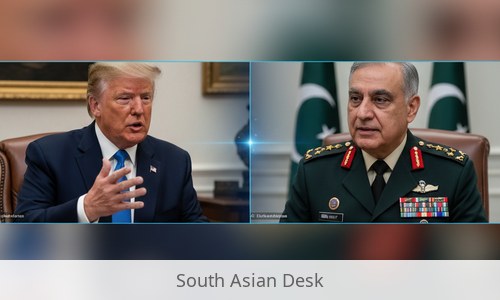
Trump Pakistan Army Chief discussions took center stage on August 25, 2026, as former U.S. President Donald Trump engaged in a critical dialogue with Pakistan’s Army Chief General Asim Munir, focusing on regional security dynamics and Iran, as confirmed by CNN. This conversation precedes Munir’s scheduled visit to Tehran, which Iran’s foreign ministry spokesperson Esmaeil Baghaei confirmed on Monday. The engagement underscores Pakistan’s evolving role as a mediator in U.S.-Iran negotiations, a position that has grown in significance amid shifting geopolitical alignments in South Asia.
Trump Pakistan Army Chief: Implications for U.S.-Pakistan Relations
Trump’s dialogue with General Munir highlights potential shifts in U.S.-Pakistan relations, which have historically been marked by both cooperation and friction. The U.S. has long relied on Pakistan for counterterrorism efforts in Afghanistan and the broader region, though tensions have often arisen over Pakistan’s perceived alignment with Islamabad’s strategic interests. This engagement signals a renewed interest in leveraging Pakistan’s strategic position, particularly as the U.S. seeks to recalibrate its approach to Iran and the broader Middle East.
Analysts note that Pakistan’s alignment with U.S. interests in stabilizing the region could lead to increased cooperation on counterterrorism and economic initiatives. However, the extent of this collaboration remains contingent on Pakistan’s ability to balance its relations with both the U.S. and Iran, a challenge that has defined its foreign policy for decades.
The U.S. has previously faced difficulties in securing Pakistan’s full cooperation due to its complex relationship with Islamabad and its regional rivals, including India and Afghanistan. This conversation with General Munir may represent an effort to re-establish a more direct channel of communication, particularly as both nations navigate the complexities of regional security.
Pakistan’s Role as a Mediator
Pakistan has long played a pivotal role in South Asian geopolitics, often acting as a bridge between regional powers. General Munir’s upcoming visit to Tehran reinforces this tradition, which dates back to Pakistan’s historical role in facilitating dialogue between Iran and the U.S. during periods of heightened tension. His discussions with Iranian officials are expected to focus on de-escalating tensions and fostering dialogue between Iran and the U.S., a task that has proven challenging in recent years.
This mediation effort aligns with Pakistan’s broader strategy to position itself as a neutral arbiter in regional conflicts, a role it has sought to strengthen through its diplomatic outreach to both Tehran and Washington. However, the success of these efforts depends on mutual trust between the involved parties and the absence of external interference.
Pakistan’s ability to maintain this neutrality has been tested in the past, particularly during episodes of heightened U.S.-Iran tensions, where its strategic interests in the region have often clashed with its desire to remain a neutral mediator. The current engagement with General Munir and the U.S. may represent a renewed effort to leverage Pakistan’s unique position to facilitate a more stable regional order.
Regional Geopolitical Context
The broader geopolitical context of this engagement is shaped by the evolving dynamics of South Asian and Middle Eastern politics. Pakistan’s strategic position at the crossroads of South Asia and the Middle East has made it a key player in regional security discussions, particularly as tensions between the U.S. and Iran persist. The U.S. has increasingly sought to engage with regional actors to counterbalance China’s growing influence in the region, a dynamic that has further complicated Pakistan’s role as a mediator. Pakistan’s ability to navigate these competing interests will be critical in determining the success of its mediation efforts.
Additionally, the ongoing security challenges in Afghanistan, including the Taliban’s consolidation of power and the potential for spillover effects into Pakistan, add another layer of complexity to the region’s security landscape. General Munir’s engagement with both the U.S. and Iran may be part of a broader strategy to ensure Pakistan’s security and stability in the face of these challenges.
Conclusion
Trump Pakistan Army Chief discussions and Pakistan’s diplomatic outreach to Iran underscore the country’s strategic significance in South Asian geopolitics. As tensions between the U.S. and Iran persist, Pakistan’s role as a mediator could shape the region’s security landscape.
The outcomes of these interactions will be closely watched by policymakers and analysts alike, as they may influence the trajectory of U.S.-Iran relations and the broader geopolitical dynamics of the region. The success of Pakistan’s mediation efforts will depend on its ability to maintain a delicate balance between its strategic interests and the need to foster trust with both the U.S. and Iran.
Follow SouthAsianDesk on X, Instagram and Facebook for insights on business and current affairs from across South Asia.