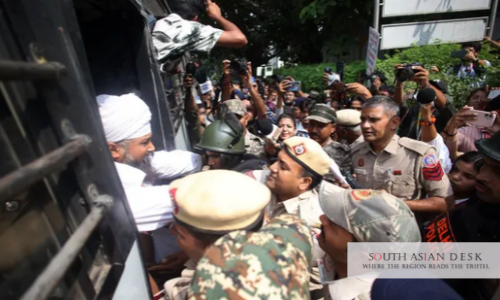
UN concern over Delhi detentions was formally voiced on October 11, 2026, when the Office of the High Commissioner for Human Rights (OHCHR) criticised the way police have handled protests in the Indian capital. The body urged the Indian government to respect the right to peaceful assembly and called for the immediate release of detained protesters. New Delhi rejected the criticism within a short time, describing it as unwarranted interference in domestic affairs.
Understanding the UN Concern Over Delhi Detentions
According to reporting by The Hindu, the OHCHR statement expressed serious concern about the conduct of law enforcement during the Delhi protests. The office stressed that any restriction placed on public demonstrations must satisfy the test of necessity and proportionality, a standard drawn from international human rights law.
Under this principle, authorities may limit assembly only where a restriction is genuinely required for a legitimate purpose, such as public safety or public order, and only to the extent that the measure is proportionate to that aim. India is a state party to the International Covenant on Civil and Political Rights, which protects peaceful assembly. The OHCHR statement framed its concerns within that wider body of obligations.
The call for release carried particular weight. By urging that detained protesters be freed immediately, the UN office signalled that it views the detentions as a matter requiring prompt correction rather than routine review. Civil society groups and international observers have reportedly echoed that demand, arguing that the authorities should act transparently and remain accountable for how they manage public demonstrations.
India’s Response to the UN
India’s response to the UN came swiftly. As reported by NDTV, the government characterised the OHCHR remarks as unwarranted interference in its internal affairs. Officials also suggested that the UN should turn its attention to large-scale protests taking place elsewhere rather than the situation in Delhi.
Indian officials maintained that law enforcement actions are carried out in accordance with the country’s legal framework. This position reflects a long-standing argument that domestic institutions, including the police and the judiciary, are the proper bodies to examine such matters.
The reaction is consistent with earlier exchanges. In 2022, for example, the Ministry of External Affairs dismissed OHCHR comments on the arrest of activist Teesta Setalvad as completely unwarranted and said they constituted interference in India’s independent judicial system. The latest dispute therefore fits an established pattern in which Delhi and UN human rights bodies disagree over where legitimate international scrutiny ends and domestic sovereignty begins.
Balancing Public Order and Civil Liberties
The disagreement highlights a tension familiar to many democracies. Governments have a duty to maintain public order and protect citizens, yet international standards require that this duty be exercised without unduly restricting fundamental freedoms. The OHCHR statement placed the emphasis on the second half of that equation, arguing that detention should not become a default response to peaceful protest.
Reports also indicate that domestic opinion is not uniform. Some officials have defended the conduct of the police, while others have reportedly favoured a more measured approach to managing demonstrations. That internal debate suggests the question of how to police protests remains open within India itself, independent of any external criticism.
What the OHCHR Statement Means Going Forward
The practical consequences of the OHCHR statement remain to be seen. The UN office has no power to compel a government to release detainees, and India has made clear that it does not accept the premise of the criticism. Even so, such statements can shape public debate, inform the work of civil society organisations and influence how other governments and multilateral bodies view the situation.
For India, the episode may prove significant in its relations with international institutions, particularly as it seeks a larger role on the global stage. For the detained protesters, the immediate question is whether the authorities will review the detentions in light of the standards the UN has outlined.
As events develop, attention is likely to centre on three issues: whether the detained individuals are released, whether the authorities offer a detailed legal justification for the arrests, and whether further international bodies comment on the matter. Each will indicate whether the exchange remains a diplomatic disagreement or becomes a more lasting test of India’s engagement with international human rights norms.
Follow SouthAsianDesk on X, Instagram and Facebook for insights on business and current affairs from across South Asia.
Sources
- UN human rights body expresses concern over Delhi detentions, urges immediate release – thehindu.com
- “Unwarranted Interference”: India Slams UN’s Remarks On Delhi Detentions – ndtv.com
Image: th-i.thgim.com