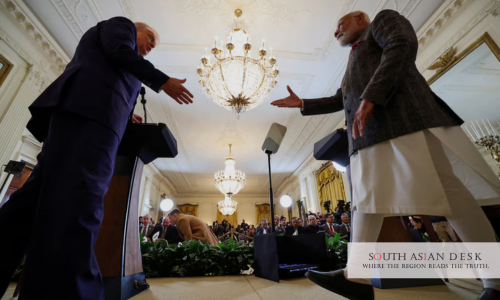
US-India trade deal negotiations appear to be moving toward a long-awaited interim agreement, but the final stretch remains complicated by tariff uncertainty, agricultural market access, legal questions in Washington and India’s demand for a competitive advantage over rival Asian exporters.
Both governments have signalled progress in recent weeks. US Trade Representative Jamieson Greer visited New Delhi from June 22 to 24 for talks with Indian Commerce and Industry Minister Piyush Goyal, with India’s commerce ministry saying both sides reviewed market access, digital trade, supply chain resilience, non-tariff barriers and cooperation in strategic sectors. The ministry said the two sides discussed pathways to conclude an interim agreement as a milestone toward a broader Bilateral Trade Agreement, or BTA.
Goyal has also said India and the United States are “very close” to finalising a deal. Reuters reported that New Delhi is pushing for a tariff rate lower than those applied to competing Asian economies, while Washington wants India to import more American goods.
US-India Trade Deal Hinges on Tariff Advantage
The central issue is no longer whether Washington and New Delhi want a deal. They clearly do. The harder question is whether the agreement gives both sides enough to sell at home.
For India, the deal must deliver a visible tariff advantage. New Delhi wants its exporters to compete more effectively in the US market against countries such as Vietnam, Bangladesh, China and Malaysia. This is particularly important for labour-intensive sectors such as textiles, apparel, leather, footwear, chemicals, gems, jewellery and manufactured goods.
The February framework had offered India a US reciprocal tariff rate of 18 percent, alongside the removal or reduction of tariffs on certain Indian goods if the interim agreement was successfully concluded. In return, India agreed to reduce or eliminate tariffs on US industrial goods and a wide range of American food and agricultural products.
That bargain became more complicated after the US Supreme Court struck down the Trump administration’s sweeping global tariffs, weakening the legal foundation behind the original tariff offer. Reuters reported that this ruling effectively removed the earlier US offer to cut tariffs on Indian goods from 25 percent to 18 percent, while India was still being asked to make long-term market-access commitments.
This is why India is asking Washington for clearer legal backing. Goyal’s position is simple: India cannot open sensitive parts of its market unless the United States can guarantee that Indian exporters will receive a durable advantage.
Agriculture Remains the Most Sensitive Area
Agricultural market access is one of the most politically difficult parts of the US-India trade deal. Washington wants greater access for American farm exports, including products such as dried distillers’ grains, red sorghum, tree nuts, fresh and processed fruit, soybean oil, wine and spirits. These products were listed in the February joint statement as areas where India would eliminate or reduce tariffs.
For the Trump administration, this matters because American farmers need new markets. China’s reduced purchases of US corn and soybeans have increased pressure on Washington to find alternative destinations for agricultural exports. India, with its huge population and growing consumer market, is an obvious target.
For New Delhi, however, agriculture is politically explosive. A large share of India’s population depends directly or indirectly on farming, and any move seen as exposing small farmers to cheaper subsidised US imports could trigger serious backlash. DW noted that American corn, soybeans and dairy are at the centre of the discussion, while Washington has also pushed for access in genetically modified crops, pulses, grains, dairy and dry fruits.
Dairy is especially sensitive. India’s dairy sector supports millions of small producers, and New Delhi has historically resisted opening it to major foreign competition. Former US trade official Mark Linscott told DW that the most sensitive issues, including dairy and genetically modified crops for human consumption, are unlikely to be part of the immediate deal.
That suggests the first phase may focus on less politically dangerous agricultural concessions, such as pulses, dry fruits, feed inputs and selected processed products, rather than a sweeping opening of India’s farm economy.
Section 301 Investigations Add Fresh Uncertainty
Another major obstacle is the possibility of future US tariffs through Section 301 investigations. After the Supreme Court ruling weakened the administration’s original tariff powers, Washington has looked to other trade law tools to maintain leverage.
Reuters reported that the USTR’s Section 301 probes into alleged excess industrial capacity and forced-labour concerns involving around 60 economies, including India, have complicated the negotiations. Earlier this month, Greer proposed additional tariffs of 12.5 percent on imports from India and several other economies under a forced-labour probe, although no final decision has been made.
This creates a problem for India. Even if New Delhi secures a favourable tariff rate under the interim trade agreement, future Section 301 actions could reduce or cancel out that advantage. For India, the risk is that it opens its market now but faces fresh US tariffs later.
This is why tariff certainty is becoming as important as tariff reduction. India wants legal commitments that protect the deal from being undermined by future unilateral action. Without that assurance, any headline tariff benefit may look fragile.
Russian Oil Tariffs Still Shape the Background
The trade talks are also tied to the wider geopolitical dispute over India’s Russian oil purchases. In 2025, the Trump administration imposed an additional 25 percent duty on selected Indian exports over New Delhi’s continued purchase of Russian oil, stacking it on top of the reciprocal tariff. DW reported that the February framework included a US commitment to reduce tariffs from 25 percent to 18 percent and rescind the extra 25 percent tariff linked to Russian oil.
That made the deal more than a trade negotiation. It became part of Washington’s effort to align India more closely with US strategic priorities, including energy sourcing, supply chain resilience and pressure on Russia.
India, however, has traditionally defended its energy purchases as a matter of national interest. New Delhi’s position has been that its priority is affordable energy for its population and economy. That tension is unlikely to disappear, even if the interim trade agreement is signed.
Digital Trade and Supply Chains Are the Strategic Prize
The US-India trade deal is not only about tariffs. It is also about the future of technology, supply chains and strategic economic alignment.
The February joint statement committed both sides to address barriers to digital trade and work toward ambitious digital trade rules as part of the broader BTA. It also referred to cooperation on supply chain resilience, innovation, investment reviews and export controls.
This is where the deal becomes strategically important. The United States sees India as a key partner in diversifying supply chains away from China, especially in sectors such as semiconductors, electronics, pharmaceuticals, critical technologies and data-centre-related products. India, meanwhile, wants greater access to US markets and technology flows as it positions itself as a manufacturing hub.
If successful, the BTA could help India move deeper into global value chains. But for that to happen, the agreement must go beyond symbolic tariff cuts and create predictable rules for businesses.
Why Both Sides Still Want a Deal
Despite the complications, the US-India trade deal is unlikely to collapse. Both sides have strong incentives to keep moving.
For Washington, India is too important strategically to ignore. It is a major economy, a China counterweight, a growing technology partner and a large market for US energy, agriculture, aircraft, digital services and industrial goods.
For New Delhi, a preferential trade arrangement with the United States could strengthen India’s export competitiveness at a time when it is trying to attract investment and expand manufacturing. The US is one of India’s most important export destinations, and improved access would be especially valuable for sectors that employ large numbers of workers.
The issue is sequencing. India wants tariff benefits and legal certainty before making politically sensitive commitments. The US wants visible market access for American exporters before giving India the competitive advantage it seeks.
A Deal Close to Completion, But Not Yet Settled
The most likely outcome is a phased agreement. The first tranche may settle easier issues: selected tariff reductions, limited agricultural access, digital trade language, rules of origin, supply chain cooperation and some non-tariff barrier commitments. Harder disputes could be pushed into later phases of the broader BTA.
That would allow both governments to claim progress without forcing a full resolution of every sensitive issue now.
Still, the final hurdle is real. India needs assurance that tariff benefits will survive US legal and political challenges. Washington needs enough concessions to justify the deal to farmers, manufacturers and trade hawks. Until both sides solve that balance, the US-India trade deal will remain close — but not complete.
Published in SouthAsianDesk, June 30, 2026
Follow SouthAsianDesk on X, Instagram and Facebook for insights on business and current affairs from across South Asia.