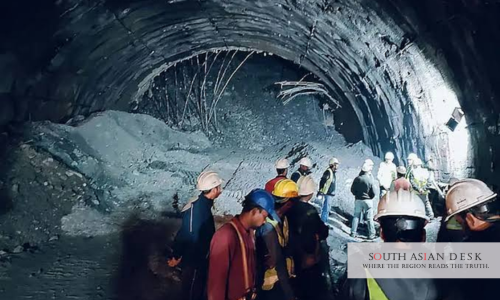
The Uttarakhand tunnel collapse at a hydroelectric project in the state’s Chamoli district has killed at least seven workers, with a rescue operation still underway to reach those who remain trapped. The incident occurred on Thursday evening at the under-construction Tail Race Tunnel of the Vishnugad-Pipalkoti Hydroelectric Project, near the village of Mayapur close to Pipalkoti, when a landslide sent a surge of water and debris crashing into the tunnel.
What Caused the Chamoli Tunnel Collapse
According to officials, workers were welding reinforcement bars inside the tunnel when a landslide struck the hillside above. The force of the slide pushed a large volume of mud, rock, and water through the tunnel entrance, cutting off the section where the crew was working. The tunnel is part of the Vishnugad-Pipalkoti Hydroelectric Project, a facility being built by the Tehri Hydro Development Corporation Limited (THDC) on the Alaknanda River. Construction at the site is being carried out by the Hindustan Construction Company (HCC).
Around 28 workers were reported to be inside the tunnel at the time of the collapse. Most were evacuated within hours, but rescue crews have had to work through unstable ground and continuing water inflow to reach the remaining men.
Uttarakhand Tunnel Collapse: Death Toll and Ongoing Rescue
As rescue teams have worked through the debris, the confirmed death toll from the Uttarakhand tunnel collapse has risen to seven, with several more workers hospitalised for injuries sustained during the accident. A handful of workers are still believed to be trapped inside the tunnel, and search efforts are continuing around the clock.
Officials from the National Disaster Response Force (NDRF) said a significant amount of water had entered the tunnel by the time rescue teams arrived, with additional seepage coming from the tunnel walls, which has slowed the recovery effort. Specialised equipment is being used to clear the affected section safely, since further debris falls remain a risk as crews dig deeper into the tunnel.
Uttarakhand Chief Minister Pushkar Singh Dhami said he is receiving real-time updates from the site and has directed every agency involved to treat the rescue as the top priority. He has also been in contact with counterparts in neighbouring states whose workers are among those affected, since many of the labourers at the site come from outside Uttarakhand.
Who Is Leading the Rescue Effort
The response to the Pipalkoti tunnel accident involves several agencies working alongside one another. Teams from the Uttarakhand Police, State Disaster Response Force, NDRF, Indo-Tibetan Border Police, and the Indian Army have all been deployed to the site. The district magistrate for Chamoli is overseeing coordination on the ground, while rescued and injured workers are being treated at the district hospital in Gopeshwar and at a charitable hospital in Pipalkoti.
Because the tunnel is still partially filled with water and loose debris, rescuers are moving cautiously. Draining the flooded section and stabilising the tunnel roof are both necessary before crews can safely push further in to search for the workers who remain unaccounted for.
A Recurring Problem for Tunnel Construction in the Himalayas
This is not the first time a construction project in the region has ended in tragedy. Less than a month before this incident, 25 workers died in an under-construction tunnel in Sikkim after a methane gas explosion caused part of it to collapse. In 2023, dozens of workers were trapped for more than two weeks after a road tunnel gave way in Uttarkashi, also in Uttarakhand, and had to be freed through a specially bored escape pipe.
The THDC tunnel disaster in Chamoli has renewed questions about safety standards on hydropower and highway projects being built through the steep, geologically unstable terrain of the Himalayas. Uttarakhand’s mountains are prone to landslides, and large-scale construction work, including tunnelling and blasting, is often cited by geologists as a factor that can further weaken already fragile slopes.
What Happens Next
Authorities have not yet given a timeline for when the search for the remaining tunnel workers trapped in Uttarakhand will conclude. Rescue teams are continuing to clear debris and pump out water in an effort to reach the last section of the tunnel where the men are believed to be. Families of the workers, many of whom travelled from other states for the construction job, have gathered near the site awaiting further news.
As with previous tunnel accidents in the state, the incident is likely to prompt fresh scrutiny of safety protocols at hydroelectric and infrastructure sites across Uttarakhand, particularly those built through terrain already known for landslides and slope instability.
Published in SouthAsianDesk, August 14th, 2026
Follow SouthAsianDesk on X, Instagram and Facebook for insights on business and current affairs from across South Asia.