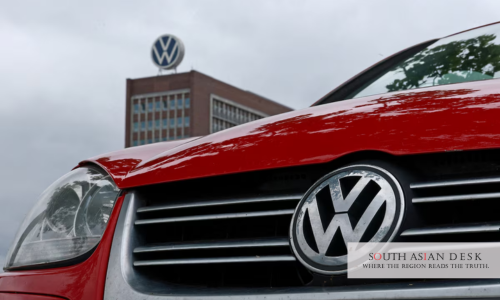
The Volkswagen tax demand case has been sent back to square one, with the Bombay High Court confirming that the German automaker will have to re-argue its challenge to a $1.4 billion customs bill before an entirely new bench. The development comes roughly a year and a half after the previous bench reserved its verdict, leaving one of India’s largest and most closely watched tax disputes involving a foreign investor unresolved for even longer.
The case, filed by Skoda Auto Volkswagen India against the Union of India, centres on allegations that the carmaker misclassified imported components to avoid higher duties, a dispute that has drawn attention well beyond the automotive sector as a test of how India handles long-running tax investigations into multinational companies.
Bombay High Court Releases Volkswagen Tax Demand Matter
The bench of Justices B.P. Colabawalla and Firdosh Pooniwalla had reserved judgment on February 26, 2025, following extensive hearings that stretched over six days. At the time, the judges clarified that their ruling would be narrowly focused on whether the show-cause notice issued by customs authorities was time-barred, rather than on the broader merits of the tax demand itself.
However, the bench indicated that its judgment was not ready for pronouncement and cited a Supreme Court ruling requiring judgments to be delivered within three months of a matter being reserved, with a further three-month extension permitted only in exceptional circumstances. Since neither timeline could be met, the bench chose to release the case rather than delay it further. “Due to the exigency of work we have not been able to pronounce judgment till date,” the bench said, adding that the matter would now be placed before a coordinate bench currently assigned to hear tax challenges arising from 2025.
As a result, the Volkswagen tax demand case must be re-argued in its entirety before the new bench. To allow the company time to bring the matter before the appropriate court, the earlier bench directed that status quo be maintained for four weeks.
Origins of the $1.4 Billion Customs Duty Demand
The dispute traces back to a show-cause notice from Indian customs authorities alleging that Volkswagen misclassified imports for its Audi, Skoda and Volkswagen models as individual parts rather than Completely Knocked Down units, which attract substantially higher duties. The notice flagged approximately 33,000 such transactions.
Skoda Auto Volkswagen India approached the Bombay High Court in 2025 to challenge the resulting ₹11,526 crore, or roughly $1.4 billion, customs duty demand. At the heart of the case is how the company classified components imported for its Aurangabad plant between March 2012 and July 2024. Customs officials contend that these imports should have been taxed as Completely Knocked Down kits, and further allege that the company used software to split vehicle orders across hundreds of global suppliers specifically to avoid the higher tax rates that apply to such kits. The show-cause notices, issued in late 2024, threatened to confiscate the imported goods and to recover unpaid duty along with interest.
Arguments From Both Sides in the Bombay High Court
Representing Volkswagen, senior advocate Arvind Datar argued that the show-cause notice was issued after a twelve-year delay, making it time-barred under Indian law. He maintained that the company had consistently imported its components as individual parts rather than as complete kits, a position he said was supported by a 2011 clarification from the revenue secretary. Datar also pointed out that the provisional assessments needed to determine the correct duty had never been completed, leaving Volkswagen unable to pass on the disputed tax burden to consumers, and he described the $1.4 billion demand as unreasonable.
Representing the government, Additional Solicitor General N. Venkataraman rejected these arguments, contending that Volkswagen had intentionally misclassified its imports and failed to disclose key operational details. He noted that the Aurangabad plant imported nearly all of its components, with only final assembly taking place in India, and argued that the imports amounted to nearly complete vehicles rather than individual parts, making them liable for classification as Completely Knocked Down units subject to duties of 30 to 60 percent. Venkataraman also said the timing of the show-cause notice was justified, as it followed new information uncovered during a raid by the Directorate of Revenue Intelligence. Customs officials separately filed an affidavit blaming Volkswagen’s own conduct, specifically the withholding of information, for delaying the twelve-year tax assessment process.
What the Fresh Hearing Means for Volkswagen
With the case now required to be re-argued from the beginning before a different bench, the Volkswagen tax demand dispute is likely to remain unresolved for a considerable period longer, adding to years of uncertainty already surrounding the matter. For Volkswagen, which has previously described the size of the demand as disproportionate to its business in India, the delay extends a legal battle that has become emblematic of the broader friction foreign manufacturers can encounter when tax authorities revisit years of historical import records. The outcome, whenever it arrives, is expected to have implications not only for Volkswagen but for how customs classification disputes involving other multinational automakers in India are argued and resolved going forward.
Published in SouthAsianDesk, August 26th, 2026
Follow SouthAsianDesk on X, Instagram and Facebook for insights on business and current affairs from across South Asia.