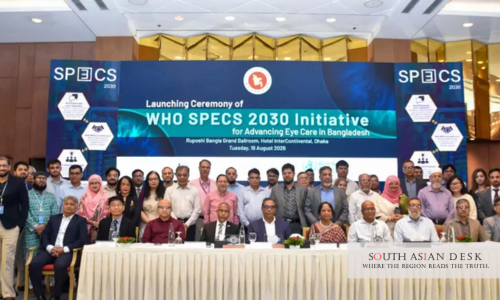
The WHO SPECS 2030 Bangladesh launch took place on Tuesday, marking a major step toward expanding access to quality, affordable and people centred eye care services across the country. State Minister for Health and Family Welfare Dr MA Muhit formally launched the initiative at a function held at a city hotel, describing it as a commitment to bringing modern eye care services down to the grassroots level.
Speaking at the event, Muhit said the government was planning to establish dedicated outpatient, inpatient and operating theatre facilities for eye care at the 151 bed hospitals currently being constructed at the upazila level. He added that nearly 500 upazilas would eventually gain access to advanced eye care facilities, reducing the need for patients to travel to district towns or to Dhaka for treatment.
WHO SPECS 2030 – National Eye Care Plan Targets 1 Million Cataract Surgeries
The National Eye Care Plan being finalised by the government forms the backbone of the country’s broader eye health strategy under the new initiative. Muhit said the plan targets around one million cataract surgeries, the distribution of several crore pairs of spectacles, and expanded treatment for diabetic retinopathy across the country. He noted that primary eye care would also be incorporated into the training curriculum for around 100,000 health workers currently going through the government’s recruitment process.
As part of the plan, the government intends to strengthen regular cataract surgery and refraction services in at least half of the country’s districts by coordinating existing infrastructure at district hospitals. Muhit said the government had spent the past six months coordinating with international and local organisations to strengthen and expand eye care services ahead of the launch.
Refractive Error Coverage Sits at the Heart of the Global Framework
Refractive error coverage is the central metric underpinning the WHO SPECS 2030 Initiative, which was introduced globally in May 2024 to improve access to refractive error services worldwide. The initiative supports countries in working toward the first global target for refractive error endorsed by the World Health Assembly in 2021, which calls for a 40 percentage point increase in effective refractive error coverage by 2030.
Orbis International Bangladesh played a key coordinating role in bringing together government agencies, the World Health Organization and other eye health stakeholders, helping drive the process toward the initiative’s national launch. At the event, representatives from WHO and the government stressed that closing existing gaps in eye care would require an integrated approach involving primary healthcare, trained personnel, functioning referral systems, affordable spectacles, reliable data, and stronger collaboration between government, WHO, non-governmental organisations, professional bodies, development partners and the private sector.
Cataract Surgeries Bangladesh Discussion Frames Wider Panel Debate
Cataract surgeries Bangladesh performs each year were a recurring theme throughout the launch event, which began with a presentation on the global, regional and country level perspectives of the SPECS 2030 Initiative delivered by Dr Tashi Tobgay, regional adviser and unit head for noncommunicable diseases, mental health and disabilities at the WHO South-East Asia Region. Prof Dr ASMM Quadir, director in charge of the National Institute of Ophthalmology and Hospital, and Dr Ahmed Jamsheed Mohamed, WHO representative to Bangladesh, also addressed the launch.
Following the formal launch, a panel discussion focused on strengthening eye care services was moderated by Dr Munir Ahmed, country director of Orbis International Bangladesh and honorary country chair for Bangladesh of the International Agency for the Prevention of Blindness. Panellists including Max Tunon of the International Labour Organization, Rajesh Narwal of the WHO, Indra Prasad Sharma of the International Agency for the Prevention of Blindness, and Johurul Islam Jewel of CSF Global highlighted the need for workplace eye health programmes, evidence based policymaking, stronger workforce capacity, affordable spectacle provision, and coordinated action across sectors.
A Framework Built on Five Strategic Pillars
The SPECS 2030 framework is structured around five strategic pillars designed to bring governments, professional associations, non-governmental organisations, academic institutions and the private sector together in expanding access to refractive error services. Officials say the national launch of the initiative is expected to provide a coordinated framework for these efforts, along with an implementation roadmap aimed at helping Bangladesh reach the global 2030 target for refractive error coverage.
Published in SouthAsianDesk, August 19th, 2026
Follow SouthAsianDesk on X, Instagram and Facebook for insights on business and current affairs from across South Asia.