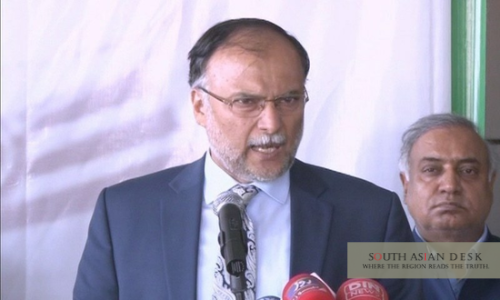
Zero-tariff access to the Chinese market has emerged as a central demand in Pakistan’s economic diplomacy with Beijing, after Federal Minister for Planning, Development and Special Initiatives Ahsan Iqbal asked China to support preferential entry for Pakistani goods. The proposal aims to raise Pakistan’s annual exports to China from around $3 billion to between $20 billion and $25 billion.
Ahsan Iqbal Presses Beijing on a Preferential Trade Arrangement
The request was made in Beijing during a meeting between the minister and Liu Haixing, who heads the International Department of the Communist Party of China Central Committee, according to a news release issued on Friday. Ahsan Iqbal followed up on a proposal that was discussed on November 3 and that Prime Minister Shehbaz Sharif had previously raised with Chinese President Xi Jinping.
To make the case for zero-tariff access to the Chinese market, the minister pointed to the tariff concessions China has extended to African countries, describing them as a possible model for improving the competitiveness of Pakistani goods. He also noted the scale of the opportunity, as China imports nearly $3 trillion worth of goods every year. Against that backdrop, Pakistan’s current exports of around $3 billion represent a very small share of the Chinese market, which explains why Islamabad is seeking a more favourable tariff arrangement.
A Knowledge Corridor for Pakistani Scholars
Trade was not the only subject on the agenda. Ahsan Iqbal also sought Beijing’s support for the proposed Pakistan-China Knowledge Corridor, an initiative that envisages doctoral studies and specialised research opportunities for around 10,000 Pakistani scholars over a period of 10 years.
According to the news release, the initiative would involve scholarships, partnerships with leading Chinese universities and co-financing. Priority areas include artificial intelligence, engineering, advanced manufacturing, modern agriculture, biotechnology and mineral sciences. The proposal reflects an effort to complement commercial ties with long-term investment in skills and research capacity.
Looking Beyond the First Phase of CPEC
The minister used the meeting to discuss the second phase of the China-Pakistan Economic Corridor, commonly known as CPEC. He identified industrial and agricultural cooperation, business partnerships, technology transfer, minerals and green development as the key priorities for the next stage.
Ahsan Iqbal recalled that the first phase of CPEC had attracted around $25 billion in investment and had added more than 8,000 megawatts of power generation capacity. It also delivered 888 kilometres of highways and motorways and created an estimated 236,000 direct and indirect jobs. Building on that record, he linked the next phase with Pakistan’s URAAN development programme and with China’s 15th Five-Year Plan, stressing the importance of policy continuity on both sides.
Political Channels and Security Assurances
The minister also proposed designating focal persons and setting timelines for implementing the memorandum of understanding signed in May 2026 between the Pakistan Muslim League-Nawaz and the Communist Party of China. The suggestion points to a desire to turn political agreements into measurable outcomes rather than leaving them as statements of intent.
On security, Ahsan Iqbal reaffirmed Pakistan’s commitment to ensuring the safety of Chinese personnel and projects in the country, a recurring concern in discussions on CPEC. He concluded by requesting updates from the Chinese side on both the market access proposal and the Knowledge Corridor.
What the Proposal Could Mean for Trade
If China were to accept the request, the effect on Pakistan’s exports to China could be significant, given the scale of the target the minister has outlined. Raising annual exports to between $20 billion and $25 billion would amount to a multiple of the current level of around $3 billion. However, the news release did not indicate whether Beijing has agreed to the proposal or offered a timeline for a decision, and the request remains under discussion.
For now, the outcome will depend on how Chinese officials respond to the follow-up that Islamabad has requested. What is clear is that Pakistan is pressing for tangible gains across trade, education and investment, and that securing zero-tariff access to the Chinese market sits at the heart of that effort.
Follow SouthAsianDesk on X, Instagram, and Facebook for insights on business and current affairs from across South Asia.