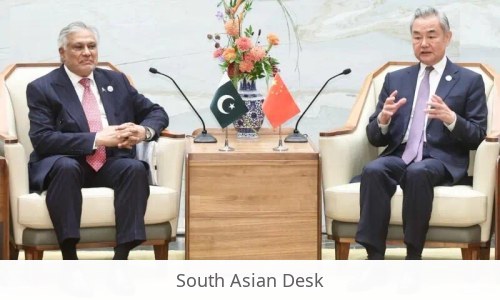
U.S.-Iran peace talks have become a focal point as China’s Foreign Minister Wang Yi and Pakistan’s Deputy Prime Minister Ishaq Dar met in Shanghai and issued a joint statement expressing concern over the deteriorating situation in West Asia. The statement called for an immediate cessation of hostilities and a return to dialogue between the U.S. and Iran, as the U.S. continues its military operations in Iran.
U.S.-Iran peace talks: U.S. Military Actions and Their Impact
Recent U.S. airstrikes in Iran have reportedly damaged Chabahar port and resulted in at least seven fatalities from attacks on bridges. The U.S. military has been engaged in a sixth consecutive night of airstrikes against Iranian targets, focusing on civilian infrastructure. China and Pakistan have raised concerns over these actions, emphasizing their potential to escalate regional tensions.
The sustained aerial campaign by the U.S. underscores a deepening cycle of retaliation and counter-retaliation that has characterized U.S.-Iran relations for decades. This cycle has made U.S.-Iran peace talks increasingly difficult to achieve, as both sides remain entrenched in their positions.
The targeting of infrastructure, including ports and transportation networks, risks severing critical supply chains that underpin regional trade and energy flows. Chabahar port, a key maritime hub for Iran and a strategic asset for India’s access to the Arabian Sea, has been particularly vulnerable. Its disruption could exacerbate economic strains on neighboring countries reliant on Iranian trade routes, including Pakistan, which has long sought to balance its regional partnerships with both Iran and the U.S.
The focus on civilian infrastructure also raises questions about the broader implications for regional stability, particularly in the context of ongoing U.S.-Iran peace talks, which have been stalled for years. Analysts note that such strikes risk drawing in other regional actors, including Gulf states and South Asian nations, which have vested interests in maintaining open trade corridors and energy pathways. The U.S. military’s extended operations—spanning six consecutive nights—highlight the challenges of de-escalation in a conflict marked by asymmetrical capabilities and mutual distrust.
The Role of China and Pakistan as Mediators
China and Pakistan have long maintained strategic partnerships with Iran, with Pakistan’s geostrategic position and China’s economic investments in the region serving as key motivators for their diplomatic efforts. Their joint statement underscores a shared interest in stabilizing West Asia, where ongoing conflict risks disrupting trade routes and energy supplies critical to South Asia. Historical ties between China and Pakistan, including the China-Pakistan Economic Corridor, further align their interests in fostering regional stability through dialogue rather than confrontation.
Pakistan’s role as a mediator is shaped by its unique position as a bridge between South Asia and the Middle East. The country has historically navigated complex relationships with both Iran and the U.S., balancing its economic and security needs. Meanwhile, China’s deepening economic engagement in West Asia, particularly through infrastructure projects and energy partnerships, has solidified its stake in regional peace.
The China-Pakistan Economic Corridor (CPEC), a flagship initiative of China’s Belt and Road Initiative, includes energy projects and transportation networks that are vulnerable to instability in the region. This economic interdependence reinforces the urgency of diplomatic solutions to prevent further conflict.
The joint statement from Wang Yi and Ishaq Dar reflects a broader trend of South Asian nations seeking to counterbalance Western influence in regional affairs. By advocating for U.S.-Iran peace talks, China and Pakistan aim to position themselves as key players in shaping the geopolitical landscape of West Asia. Their efforts align with a growing emphasis on multilateralism and regional cooperation, as seen in initiatives like the Shanghai Cooperation Organization and the Quad, which seek to address security and economic challenges through collective action.
Follow SouthAsianDesk on X, Instagram and Facebook for insights on business and current affairs from across South Asia.
Sources
- West Asia war LIVE: China, Pakistan call on U.S. and Iran to resume talks – thehindu.com
- China and Pakistan call on US, Iran to resume talks, cease hostilities – dawn.com
- US deploys jets, drones, and warships for sixth straight night of attacks on Iran | Video – indianexpress.com
- US bombards Iran in sixth-straight night of attacks – aljazeera.com
Image: i.dawn.com