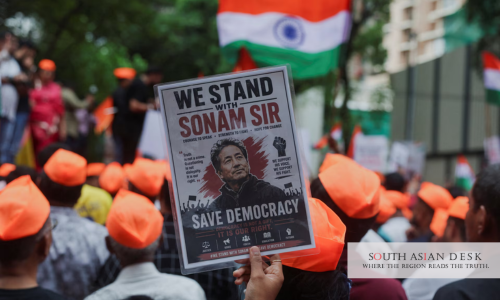
The Cockroach Janta Party protest reached a new peak on Monday as thousands of demonstrators gathered at Jantar Mantar in central New Delhi, defying a police ban to march toward parliament and demand the resignation of Education Minister Dharmendra Pradhan. The rally, held on the opening day of parliament’s monsoon session, is widely regarded as the most significant public challenge yet to Prime Minister Narendra Modi’s third term in office.
Supporters began arriving through the night, chanting slogans in Hindi calling for both Pradhan and Modi to step down. Police and paramilitary personnel had heavily barricaded the area in the days before the march, and by Monday morning scores of security forces were stationed across the capital to prevent demonstrators from advancing on the parliament building. Officers eventually used tear gas and batons to disperse the crowds after protesters attempted to breach the barricades, and Delhi Police confirmed that more than seventy people had been detained. Despite the crackdown, many demonstrators regrouped and continued moving toward parliament in smaller clusters.
Sonam Wangchuk Hunger Strike Deepens the Standoff
The Sonam Wangchuk hunger strike has become a central flashpoint in the unrest. Wangchuk, an education reformer who had been fasting in solidarity with the movement for eighteen days, was removed from the protest site by plainclothes police on Saturday and taken to hospital, reportedly having lost more than eighteen pounds during the strike. His removal galvanised supporters, who accused authorities of silencing a peaceful campaigner, and prompted thousands more to converge on Jantar Mantar ahead of Monday’s march.
The Cockroach Janta Party has since demanded Wangchuk’s release, along with the resignation of Pradhan and financial compensation for the families of students who died following the paper leak that sparked the movement.
Origins in Exam Paper Leaks and Youth Frustration
The movement traces its name to a remark made in May by India’s Supreme Court chief justice, who compared some unemployed young people to cockroaches during an unrelated hearing. Rather than take offence, disaffected students and jobseekers adopted the label, and the Cockroach Janta Party grew rapidly into a satirical but increasingly organised political force with millions of followers on social media.
Momentum built after the leak of a national medical entrance examination in May forced roughly two million students to resit the test, an episode that members describe as evidence of entrenched corruption within the education system. Local reports indicate that around a dozen students have died by suicide in the aftermath of the leak, and the party is seeking compensation of ten million rupees, or about $104,000, for each affected family.
Government’s First Response to the Cockroach Janta Party Protest
For months, the government largely ignored the movement, and Pradhan has so far refused to resign, having previously described protesters as a group attempting to divide the country. On Monday, however, officials appeared to make their first real overture. Party spokesperson Saurav Das said Health Minister J.P. Nadda met movement representatives for roughly ten minutes at his residence, and fellow spokesperson Ashutosh Ranka said Nadda had asked for time to discuss the group’s demands within government. Neither Pradhan’s office nor the ruling party responded to requests for comment on the meeting.
Solidarity demonstrations also spread beyond the capital on Monday, with protests reported in Mumbai and Bangalore, where police detained and removed demonstrators, and a candlelight vigil held in Goa calling for Modi’s resignation. Party leaders, including founder Abhijeet Dipke and Wangchuk’s wife, Gitanjali Angmo, continued a sit-in near Jantar Mantar into the evening, insisting the protest would go on.
What Comes Next
With parliament’s monsoon session now underway and the government signalling a willingness to talk, the coming days are likely to determine whether the Cockroach Janta Party protest evolves into a sustained political negotiation or hardens into a prolonged standoff. Much may depend on Wangchuk’s condition in hospital and on whether Pradhan faces further pressure from within his own party to address the movement’s core grievance: restoring public trust in an examination system that millions of young Indians depend on for their futures.
Published in SouthAsianDesk, July 21, 2026
Follow SouthAsianDesk on X, Instagram and Facebook for insights on business and current affairs from across South Asia.