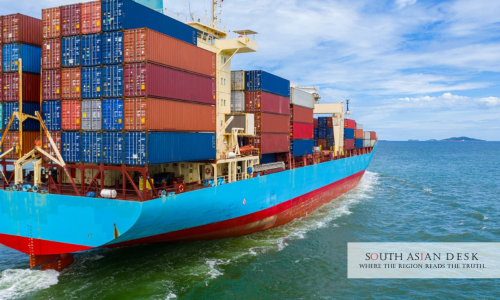
Port Qasim investment plans are expected to attract around $2 billion from investors in China, Qatar, Türkiye and the United Arab Emirates as Pakistan seeks to modernise its second major commercial port and improve its maritime logistics network.
The proposed investment would be deployed over the next 30 years to expand port infrastructure, deepen the navigation channel and improve connections between Port Qasim and Pakistan’s road and railway networks.
The wider development programme also includes a $250 million dredging project, new infrastructure for transporting minerals from the Reko Diq mine and a rail connection between Port Qasim and Pipri.
However, details of the companies expected to provide the $2 billion, the amounts associated with individual projects and the timetable for securing binding commitments have not been disclosed. The figure should therefore be treated as a long-term investment target rather than a single confirmed transaction.
Port Qasim investment plan to support long-term modernisation
The Port Qasim investment programme forms part of a broader government effort to develop the port into an integrated industrial and logistics centre.
The reported foreign investment is expected to support new cargo-handling capacity, industrial facilities and transport infrastructure. The programme would bring together maritime operations, railway freight services, road connections and logistics parks to reduce delays in the movement of goods.
Port Qasim is already surrounded by a major industrial zone serving energy, manufacturing and export-oriented businesses. The government’s master plan seeks to build on this existing base by attracting further private investment and improving the infrastructure required to support larger cargo volumes.
In January, the Ministry of Maritime Affairs outlined plans for a climate-resilient Port Qasim Industrial Complex covering more than 14,590 acres. The proposed complex has been divided into north-western, eastern and south-western zones for industrial, commercial and logistics development.
According to the ministry, Port Qasim currently hosts 833 operational units, while another 40 units are under construction. The government has presented the complex as a long-term platform for industrialisation, exports and maritime trade.
Dredging project to accommodate larger vessels
A central component of Port Qasim modernisation is a $250 million dredging project that has entered its first phase.
The project is intended to deepen the port’s navigation channel sufficiently to accommodate vessels with drafts of up to 18 metres. A ship’s draft measures the vertical distance between the waterline and the lowest point of its hull.
Increasing the permitted draft would allow a wider range of heavily loaded vessels to enter the port. Larger ships can carry more cargo on a single voyage, potentially improving shipping efficiency and reducing transport costs per unit.
The Port Qasim dredging project will require continued maintenance because sediment naturally accumulates in navigation channels. The commercial benefits will therefore depend not only on the initial capital work but also on the port’s ability to maintain the required depth.
The available report does not identify the contractor responsible for the first phase or specify when the entire dredging programme is expected to be completed.
Reko Diq export infrastructure planned at Port Qasim
The development programme is also linked to Pakistan’s preparations for transporting minerals from the Reko Diq copper and gold project in Balochistan.
Reko Diq Mining Company is expected to invest $150 million in infrastructure at Port Qasim as work begins on a railway system for moving mineral products from the mine to the coast.
The planned facilities would provide Reko Diq with access to maritime export routes once commercial production begins. Mining operations of this scale require dedicated systems for transporting, storing and loading large volumes of mineral concentrate.
The Port Qasim investment associated with Reko Diq is separate from the reported $2 billion long-term foreign investment plan, although both projects form part of the wider expansion of the port and its freight network.
Further details have not been released regarding the facilities to be built at Port Qasim, their cargo-handling capacity or the allocation of costs between the mining company, Pakistan Railways and the port authorities.
Pipri rail link to connect port with national network
A new railway connection between Pipri and Port Qasim is also being developed as part of plans to improve freight transport.
The link has been associated with the broader ML-1 railway project and is expected to connect Port Qasim more effectively with Pakistan’s main railway network. It may also be used to transport Thar coal to the port for possible export in the future.
At present, much of the cargo moving to and from Karachi’s ports depends on road transport. Heavy freight vehicles contribute to congestion on industrial and urban routes and can increase delivery times between terminals, warehouses and production centres.
A functioning Pipri-Port Qasim railway connection could shift part of this cargo from roads to trains. Rail transport is generally better suited to moving large volumes of minerals, coal and other bulk goods over long distances.
The effectiveness of the new connection will depend on the condition of the wider railway network, the availability of rolling stock and coordination between Pakistan Railways, the Port Qasim Authority and private terminal operators.
Pipri logistics park included in transport plan
Authorities are also planning a multi-modal logistics park at Pipri to manage cargo transfers between road and rail services.
The Pipri logistics park is expected to provide storage, consolidation and freight-handling facilities outside the most congested sections of Karachi. Cargo arriving by train could be transferred to trucks for final delivery, while export goods could be assembled at the park before being transported to Port Qasim.
By shifting some freight-handling activity away from the port and urban roads, the logistics park could reduce pressure on Karachi’s main transport corridors.
The project is part of an effort to integrate sea, rail and road transport into a single logistics system. Such integration requires more than physical construction. It also depends on compatible cargo-tracking systems, customs processes, terminal schedules and railway operations.
No completion date or final cost has been announced for the Pipri logistics park.
Integrated port network proposed for Pakistan
The government is considering a wider transport system connecting Port Qasim, Karachi Port and Gwadar Port.
Each port serves a different combination of cargo, industrial and strategic requirements. Connecting them through an integrated port network could allow cargo to be distributed according to available terminal capacity, shipping routes and inland transport links.
Port Qasim handles containerised cargo, bulk commodities, liquid chemicals, energy imports and industrial raw materials. Karachi Port remains a major gateway for national trade, while Gwadar is being developed as a deep-sea port with potential links to western China, Central Asia and Afghanistan.
An integrated system could improve coordination among the three ports, but its implementation would require substantial investment in railways, roads, digital infrastructure and customs management.
The proposal remains at the planning stage, and authorities have not announced a unified construction schedule or institutional framework for connecting the ports.
Port Qasim investment depends on binding agreements
The reported interest from investors in China, Qatar, Türkiye and the UAE indicates that Pakistan is seeking a diverse group of international partners for Port Qasim modernisation.
Foreign investment could reduce the pressure on public finances and provide access to technical expertise in port operations, dredging, industrial development and logistics management. The structure of the investment will nevertheless be important.
Long-term port projects may be developed through concessions, public-private partnerships, leases or direct investments by terminal operators and industrial companies. Each arrangement creates different obligations relating to financing, revenue sharing, tariffs, land use and operational control.
The available information does not clarify which investment model will be used or whether agreements have been signed with investors from all four countries.
The next stage will therefore require the government to convert investment interest into bankable projects supported by clear contracts, regulatory approvals and implementation schedules.
If completed, the Port Qasim investment programme could increase maritime capacity, support mineral exports and improve freight movement between the coast and Pakistan’s industrial regions. Its impact, however, will depend on timely execution of the dredging work, railway link, logistics park and associated port infrastructure.
Published in SouthAsianDesk, July 20, 2026
Follow SouthAsianDesk on X, Instagram and Facebook for insights on business and current affairs from across South Asia.