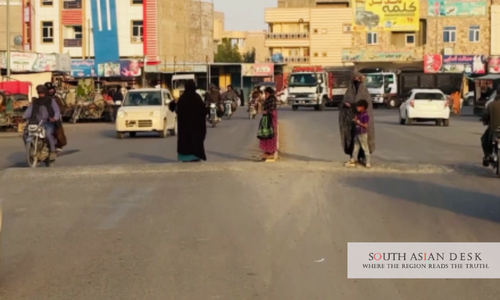
Afghan women returnees in Nimroz province are increasingly turning to begging to support their families, as poverty, unemployment and a lack of financial assistance leave many struggling to meet even their most basic needs. In Zaranj, the provincial capital, women who have returned from Iran say they have been unable to rebuild their lives and have little choice but to rely on the generosity of strangers to feed their children.
Among them is 50-year-old Negar, who is responsible for providing for a family of 11. With no other source of income or family member able to cover their daily expenses, she says she must leave her home every morning to ask people for money. The physical demands of begging have not offered her any respite, even during periods of extreme heat or cold.
Negar told TOLOnews that she continues to go out onto the streets because, without the money she receives from passers-by, her family would go hungry. Her account reflects the difficult circumstances facing women who return to Afghanistan without the financial resources or support networks needed to establish a stable livelihood.
Afghan Women Returnees Face Poverty and Limited Employment Opportunities
Negar is not alone. Several other women in Zaranj have described similar struggles, linking their reliance on begging to poverty and the lack of employment opportunities available to them after returning from Iran.
Zahra, another woman interviewed by TOLOnews, said she had returned to Nimroz from Iran but had been unable to find work or secure assistance to meet her basic needs. She said that neither government institutions nor aid organisations had provided her with the support necessary to overcome her financial difficulties.
For Gul Khumara, the situation is particularly difficult because she is caring for two children while her husband remains stranded in Iran and is unwell. With no one else available to provide for the family, she says begging has become her only means of obtaining food for her children.
These accounts highlight the challenges faced by women who return to Afghanistan without a reliable source of income. For families that have depended on migration for their livelihoods, returning does not necessarily mean that the conditions which prompted them to leave have improved. Instead, some find themselves facing unemployment, financial insecurity and the added responsibility of supporting dependants.
The wider humanitarian situation has also placed considerable pressure on returning families. A United Nations returnee overview published in November 2025 estimated that approximately 2.26 million Afghans had returned from Iran and Pakistan during that year up to October 31. The report noted that large-scale returns were placing additional pressure on housing, employment markets and essential services, particularly in urban centres and surrounding districts. Women-headed households were also a significant part of the returning population.
Growing Begging Crisis Raises Concerns Over Children in Zaranj
The increasing number of women begging in Zaranj has also raised concerns among local residents, particularly over the involvement of children. Residents say that children are increasingly being seen begging in streets and public spaces, potentially exposing them to risks and disrupting their access to education.
Abdul Karim, a resident of Nimroz, expressed concern that the growing reliance on begging could have lasting consequences for children. He warned that children who are forced to spend their time asking strangers for money may lose opportunities to attend school and enjoy a healthy childhood. He called on the authorities to take practical measures to support struggling families and prevent the situation from worsening.
The involvement of children points to a problem that extends beyond immediate household poverty. When families cannot afford food and other essentials, children may be drawn into activities that interfere with their education and development. Without sustained support, financial hardship can therefore affect not only the current living conditions of returning families but also the future prospects of their children.
Nimroz Officials Report Cash Assistance for Nearly 200 People
Local officials in Nimroz say they have taken steps to assist people who depend on begging. According to Mohammad Nabi Mohammadi, Head of Analysis and Evaluation at the Counter-Narcotics Department in Nimroz, authorities have registered nearly 200 families or individuals who rely on begging and provide monthly cash assistance to identified beneficiaries.
Mohammadi said that payments range from 2,000 to 5,000 Afghanis, depending on the financial circumstances and needs of each recipient. He added that officials continue to identify people begging in different parts of the city and are working to extend assistance to others in need.
However, the accounts of women interviewed by TOLOnews suggest that existing measures have not addressed the difficulties experienced by everyone. Several said they had received no assistance from government institutions or humanitarian organisations. The gap between the assistance reported by officials and the experiences described by these women raises questions about the reach of existing programmes and whether vulnerable returning households are being adequately identified.
There are also broader humanitarian efforts directed towards Afghans returning from Iran. UN Women has previously documented the difficulties faced by women returning to Afghanistan, including the loss of livelihoods, inadequate housing and limited access to essential services. Its reporting has highlighted the importance of protection, healthcare and support for women and girls during the return and reintegration process.
UNHCR also provides cash assistance and other services to eligible returnees arriving through designated reception centres, including Zaranj. However, eligibility requirements apply, and such programmes should not be assumed to cover every returning family or person experiencing financial hardship.
Long-Term Support Needed for Returning Families
The women interviewed in Nimroz are calling for more than occasional financial assistance. They want authorities to create employment opportunities and introduce longer-term support measures that would allow them to provide for their families without having to beg.
Their circumstances illustrate the difficulties of reintegration for Afghans returning from neighbouring countries. Returning families may arrive with limited savings, few employment prospects and considerable responsibilities, while the communities receiving them are themselves facing economic and humanitarian pressures.
For women supporting large households, the absence of stable income can make even basic necessities difficult to afford. Cash assistance can provide temporary relief, but sustainable employment, access to essential services and targeted support for vulnerable households remain important to improving their circumstances.
The situation in Zaranj also underscores the need to protect children from being drawn into street begging. Ensuring that families can access food, financial support and education is essential if children are to avoid carrying the burden of their households’ economic difficulties.
For Negar, Zahra and Gul Khumara, the immediate concern remains the same: finding enough money to feed their families. Their experiences show that returning to Afghanistan does not necessarily bring an end to hardship. Without practical and sustained support, many women who have returned from Iran may continue to face the difficult choice between going hungry and asking strangers for help.
Follow SouthAsianDesk on X, Instagram and Facebook for insights on business and current affairs from across South Asia.
Read More: